Wednesday, April 30, 2014

We Are Born Into This World

Grace Cathedral

We are born into this world, into our fate,
Driven by a will to live,
Inheriting our present moment,
Our ancestors,
Our history,
Our natural world.
 

We are born with the freedom to choose,
And that choice is:
To follow our evolutionary impulse, to grow and do good;
Or to pursue a less noble path,
Against our conscience.
 

To choose the evolutionary path, some would call Tao, some the Path of Knowledge, some the Way,
Is to follow our hearts.
To follow this path is to face fear and grow courage,
To find clarity,
To gather power,
To accumulate wisdom,
And in the end to know death.

One cannot follow this evolutionary impulse without the awareness of this choice.
To be awakened to this choice is to become religious in some sense,
To become aware of the spiritual world we live in, and the consequences of our choices,
To accept that a solely rational thought process excludes and denies intuition,
Upon which so much depends.


It is to accept the value and meaning of inspiration,
To create,
To dance, paint, sculpt, write, to invent,
To help others, to feel the earth’s heartbeat
In our own hearts,
To reflect the music of the deeper world
In the radiation of our beings,
In our light and life.

Therefore, if we wish to enjoy this life,
We must cultivate our awareness of this evolutionary impulse within us, and
Choose to believe that our choice to follow it is for our own good and the good of the world.

Tuesday, April 29, 2014

Finding Balance in the Effort to Integrate Kundalini

One day there was a Me; the next day there wasn’t. One day I was practicing meditation, breathing in and out in a rhythmic manner; the next I was transported to another dimension I’ll never be completely able to explain or describe. That doesn’t mean I’m going to stop trying. After all, I have one advantage: I never really returned from that other dimension; I live with a foot in both — the physical world we know as the “real world” and that other dimension. To describe it, I use terms from science as well as those from various spiritual traditions, not because I like arcanum or confusion, but because when I say kundalini, you’ll say chi, someone else will say orgone; and we’ll be talking about the same thing without knowing it.


Legs up
Are You Upside Down or Rightside Up
Nevertheless, once it happens to you, you'll understand how unimportant terminology is. Each awakening experience is only a different manifestation of the same energy. Sure, it involves struggling with terminology and understanding the same notions phrased in slightly different ways. The closest we get to clarity is a series of approximations of an actual awakening experience. And that's perfectly understandable because it’s not easy to express or describe. But there is a constant: everyone who experiences Kundalini has one foot permanently in that other dimension.


Mahatma Gandhi
Self-explanatory
There’s a corollary to that constant, one we learn, not during the Kundalini activation experience per se because during the experience we are floating in a no-mind state, at least I was. Immediately after — when we “come back to our senses” — we know there is an all-pervading consciousness behind the universe and behind human evolution. It’s not a hallucination or a projection of aberrant mental activity.

This consciousness is much greater than our bodies or the physical world we perceive. We are part of it, contained in it. In this consciousness, nothing is separate. All is Whole and Undivided. This cannot be learned in school or books, it can only be Known.


Hula hoop
Ever Increasing Concentric Circles
Very few of us progress straight from birth to self-actualization. To perceive whole and undivided Oneness, we first serve an apprenticeship, as it were, in a world of duality, a world in which every aspect seems to be in opposition to every other. This is not reality; it is the world of the senses, one we are conditioned to from birth. Once we recognize that we are conditioned to think in terms of duality, we are able to find ways and means of extracting ourselves from that conditioning; and we are offered the opportunity to do so.

Many individuals are so completely conditioned they remain that way for the rest of their lives. Some are able to recognize this conditioning. A few are able to work their way through it to the cosmological Oneness behind duality. Those who achieve this may attempt to integrate this knowledge with their real world lives; others are content to remain immersed in the bliss they’ve discovered. I chose a balance: remaining in the world, at the same time, realizing I am a part of an Energy Continuum. I didn’t really choose It; It chose me. That’s the kind of purposeful compulsion Kundalini introduces into our lives. After awakening, we can’t take credit for anything we do, say, or write. We are driven to it.

Yet, spurred on by an urge to understand my experience to the extent I can — how conventional science views evolution as opposed to how someone like myself, a person with a foot in two different worlds, perceives it — I concluded that Kundalini is an evolutionary force with a guiding intelligence behind it, and I looked for an evidence-based paradigm for examining it.


Now Playing
Let's All Go to the Movies
Science recognizes “survival of the fittest” and “natural selection” as the operative mechanisms behind evolution. But is there another mechanism working at a higher level, one Gopi Krishna called the evolutionary impulse? Not perceptible by everyone at this time, this mechanism drives certain beings toward super-consciousness, allowing them to recognize and access energy fields beyond the confines of the circumscribed physical universe, beyond the five senses. Those who do experience it say this super-consciousness manifests itself as vibrational energy. If so, could it become perceivable at some future time by all humans as a result of a rapid surge in the quality of human evolution? A new tip of Maslow’s pyramid dedicated to higher consciousness? In other words, could all human beings eventually become conscious of consciousness at each and every moment of their lives?


Hand to mouth
Preparing for the July Fourth Nacho Eating Contest
Is the objective study of Kundalini a fool’s errand? Perhaps, but Kundalini is a many-sided subject. I believe we can learn from an evidence-based approach to studying its role in evolution.

Friday, April 18, 2014

The Ego is the Root of all Diseases...Give It Up

I came across the title of this blog post while surfing Facebook. I couldn't believe that it received over 1,000 "Likes" and was shared over 300 times. What is it about that sentence that moved so many people to respond? Whatever it was that responded it wasn't the ego. In fact, the ego is the price paid for what is actually given up. Reading this sentence I asked myself the question "how." How do I give up ego? It's a topic I have long pondered.


After reading great words of wisdom in books, I always come back to the how. As I write this, I am reminded of the old proverb: Give me a fish and I eat for a day; teach me to fish and I eat for a lifetime. Spiritual writing affects me that way. The reading part is like being fed a fish. When I close the book, I am still hungry, still feeling the truth of becoming spiritually self-sufficient has eluded me. In the weeks leading up to my first experience of Kundalini, I was frustrated about not being able to find the tools for achieving the promised altered state of consciousness — whether it be awakening or enlightenment — in any of the writings I had come across.

In order to give something up it is necessary to understand how it is constructed in the first place. The ego is a construct, but just knowing that is not enough to enable one to give it up. Actually, it isn't giving it up as much as it is dismantling it and then realizing it is unreal. The process
demands rigorous and authentic self-observation, which is impossible to do on one's own. This is why the importance of the guru or the adept has been emphasised through the ages. The ego is always more cunning and clever than the soul. The ego is what Gurdjieff called the false self and it is constructed from life experiences. Not so much the experiences themselves, but the stories we manufacture around them and what we make these stories mean.

There are three ego development stages in life. The first comes around the age of 4-5 when the unconscious thought "there's something wrong here" appears and a way of being (pattern of behavior) is created to survive. This is the first construct of the false or ego self.

 The next stage happens during the teenage years when  thoughts like "I don't belong" arise and a second survival strategy is put in place, based largely on "fitting in." This ego layer is difficult to dislodge because it is a deeply ingrained protective mechanism.

The final stage happens sometime in the 20s when the thought "I'm on my own" surfaces and another survival mechanism is put in place. The sum total of the decisions and strategies adopted in consequence to these three events are what constitutes the ego. And the fact that they become so deeply buried in the persona is why the ego stays so well hidden, even after one finally goes looking for it.

It took an intense weekend of self-development training to enable me to see the who I thought I was wasn't the who I really am. Seeing those three events with perfect clarity allowed me to realize that what I had made them mean shaped the who I was. As a result of those insights and realizations something fell away and I experienced an unbounded peace and bliss. This happened in 2005.

I'm not saying that I am now ego-less; I'm not, but who I am for myself is now much more flexible and I am able to see the play of the manifested with that of the un-manifested. Dismantling the false or ego self is an absolutely essential step in the spiritual awakening process.

Sunday, April 13, 2014

Cosmology and the Life of Pi

Whenever we analyze something, anything, we are only seeing a part of a larger whole. Thus, we rely on something other than our immediate reason to make sense of our choices. Why did we focus on this or that? Can we really rationalize why we do what we do?

Sure, we guess, speculate, estimate what our motives are, but the fact is that motivation is pre-intellectual. It happens before we think, because in motivation is choosing what to focus the mind on. This goes to the heart of major choices in our lives. Why did we choose this or that spouse? Why did we leave college for a time, and go back with a new goal? Why do we vote the way we do, if we vote at all?

What tools do we have to maintain a sense of sanity in this profusion of unconscious drives and a reason that may or may not conflict with the real workings of unconscious motivations? For many, it is a belief in God, or something mystical, The Force, the Great Spirit, Brahman, the Tao, and so on. In human psychology, the function of this is to explain in lump sum all the unconscious energies that control our lives.

Whether we include the Big Bang Theory with religious cosmologies or not is a question to be debated for a long time to come. I enjoyed the film Life of Pi on this subject. This beautifully photographed film examines the question of which story of creation one should believe.

In the film, the narrator seeks to know the meaning of God. The protagonist, Pi, presents two creation myths: the Christian version in which God sends his only son to Earth where he is crucified; and the story of Krishna, whose mother is afraid he has been eating dirt and looks in his mouth to check. There she sees the moon and the stars.

On a lifeboat with a Bengal tiger, Ang Lee
Life of Pi
Life of Pi is the story of surviving a shipwreck and Pi's sharing a lifeboat ride across the Pacific with a Bengal Tiger. Pi relates two stories to the Japanese Insurance company that insured the ship. One story concerns him and the tiger; the other, a fight to the death with his mother's murderer on board the lifeboat. One story is, of course, a metaphor for the other. Pi is the tiger.

Pi asks which story do you want to believe? It doesn't matter, he says. There was a shipwreck, and he is the only survivor. The Japanese insurance men prefer the tiger story. "...and so it is with God," Pi tells the narrator. Do you want to believe the Christian cosmology or the Hindu version? It makes no difference, since the world was created and we have to live in it. Believe whatever makes you happy.

It is faith that allows us to live day after day, faith that there is a larger spiritual medium that supports all we do and gets us through life. A loss of this faith causes people to despair, to lose hope, to become cynical and bitter. This is not the faith of a child who is taught that a parental God looks after us. Nevertheless, we accept the need for faith by understanding that one human life is trivial in the grand scheme of things. The daily newspaper bears witness to the tragic ways that people die — in hurricanes and tornadoes, landslides and plane crashes.

No, it is a faith that there is more to this life than a simple bio-mechanical construct that sees only a physical world. It is faith in the surrounding energetic world and the inner sensorium that drives us, these drives of living energy that push us forward through our days. That faith is a source of strength, of motivation, and of values.

Wednesday, April 9, 2014

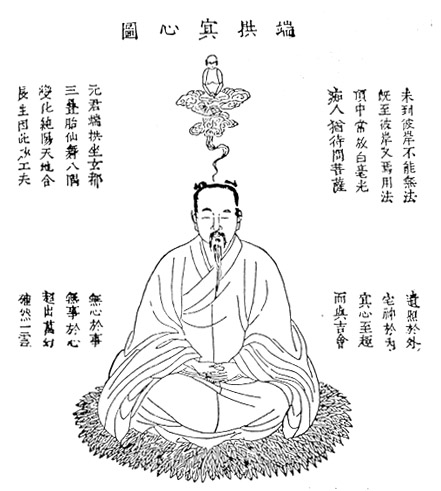
The Secret of the Golden Flower - Revisited, Part II

For over 40 years, I’ve practiced Golden Flower Meditation (GFM), the method in The Secret of the Golden Flower (SGF) that many adepts recognize as derived from the Buddha’s own meditation system. When I first started, I had no idea it was a manual for activating kundalini...

https://amzn.to/2JiTRhj

Perhaps it was because the Wilhelm translation of the SGF has a poetic quality that obscures unambiguous execution of the meditation teachings embedded in the text. Metaphor rather than easy-to-follow, step-by-step explanation is the norm. A modernized How-To it is not. Terminology often sidesteps the underlying process, hints at it, leaving you to wonder if you are doing it correctly. Some terms overlap in meaning; some techniques are referred to by more than one term. Only by obstinate practice do the techniques become clear.

Nevertheless, I kept at it. I’m not sure why. Part intuition, I suppose. Part distrust of mass movements: I was turned off by Scientology and similar movements that herded initiates toward obedience as dictated by a single leader. Buddha and Milarepa had done it on their own. Why couldn’t I?

Life in 1970 — when I started meditating — was quite different from today. No Internet, not many books on yoga or meditation. It took me over a year to understand the method and practice it in a systematic manner. The one thing that kept me motivated was that, once I caught onto the breathing techniques, I began to detect sensations of energy stirring and flowing throughout my body.

I became a skilled observer, applying techniques in a manner best suited to my particular morphology and soma. I created a step-by-step order for my practice, which turned out to be important because it’s not possible to jump over or skip a step; each one has to be mastered before moving on to the next one.

I stress the point about becoming a skilled observer as much as I stress learning to meditate on your own. Groupthink never gets it done; you can only learn so much from others. The real work is done in the laboratory of your own body. You must become your own best “spiritual” detective.

Individuality vs Groupthink
It Takes Courage to Go It Alone

GFM has entirely reengineered my nervous system, body, and brain. The method is composed of three techniques, each of which must be mastered in turn before beginning the next:

  1. Diaphragmatic Deep Breathing (DDB)
  2. Control of Heart Rate
  3. The Backward-Flowing Method (BFM)
Chi, prana, micro-cosmic orbit
The Backward-Flowing Method

It’s a system that Gopi Krishna, the 20th century’s great elucidator of Kundalini, described as “containing unmistakable hints about the sublimation process.”

He’s referring, of course, to sexual sublimation, a process that uses distilled sexual energy to wake up the nervous system and revitalize the brain and the body, ultimately triggering Kundalini. Although sublimation sounds mystical, it is really a biological process, entailing the diversion of  sexual energy to the brain. Instead of flowing out, as it does during normal sexual intercourse, the seminal fluid, or cervical fluid in a woman, is diverted to the brain in a distilled form known as prana, which is the key to enhanced neuroplastic activity in the brain.

 
Sexual sublimation is the basis of activating Kundalini in whatever form it takes. I say this because the Kundalini experience takes many forms, probably because the sublimation process takes so many forms. Hidden channels can open in dissimilar ways, triggering a flow of distilled sexual energy to the brain that varies according to individual metabolism and soma:
“For a week I observe my breath circulate in the opposite direction without noticing any effect. The mind goes on autopilot and I go back to my uninspired routine: walking, cooking, meditating. Then, two weeks later, about the length of time it takes the backward-flowing process to become permanent, there’s something new. On the day in question, I feel a sensation at the base of my spine like the cracking of a small egg and the spilling out of its contents. For the next month, I observe the fluid-like contents of the egg trickle out of its reservoir and slowly begin to climb my spine. What is this fluid? I can’t describe it exactly. It seems to emanate from the base of the spine and press upward. Each time I sit to meditate, it has risen a half an inch higher.”
~ Excerpted from, Deciphering the Golden Flower One Secret at a Time
Meditating is easy for some, but not for others. It took me a long time to get comfortable with the process, to learn the posture and to concentrate. I was alternately bored and restless, fidgety and impatient, sleepy and indolent. Sitting in the lotus position, my mind used the time to review the events, impulses, and relationships in my life. I was powerless to stop this inner dialogue, to clear my mind of chatter. I knew it could be done; others had written about it. To succeed in meditation, it had to be done; all the teachings said so.

"Nor must a man be led astray by the ten thousand ensnarements. This happens if, after the quiet state has begun, one after another all sorts of ties suddenly appear. One wants to break through them and cannot; one follows them, and feels as if relieved by this. This means the master has become the servant. If a man tarries in this stage long he enters world of illusory desires."
~ The Secret of the Golden Flower

I dropped everything and concentrated on meditation in the hope it would improve my breathing, allowing me to become a better musician. However, sitting in the lotus position, I couldn’t get the breathing right. One day while walking, I decided to sync my breathing to each step, counting my breath over a series of strides. Exhale four counts, hold four counts, inhale four counts, hold four counts. Start over. I practiced a lot, walking great distances until my breathing became regular. The process of counting obscured the chatter, and it gradually disappeared. Eventually, I stopped counting; my mind had emptied. And I returned to sitting meditation, which then kicked into high gear. It had taken me over a year to get my mind under control, but once I was able to, the meditation advanced quickly.
As a result, my Kundalini activated at the age of 35. Energy I didn’t know existed started flowing through the neural channels of my body. I could feel and observe it. Almost immediately, I realized that this pranic, super-conscious energy was the Primal Spirit, a term I’d come across many times in The Secret of the Golden Flower without really understanding what it meant.

It took about three months for this process to complete. I never felt sexual arousal, rather a benign hydraulic sensation, as if a liquid was slowly being “pumped up” my back. Should you succeed in activating "the circulation of the light," as explained in Part I of this post, the outcome will probably differ from mine, or from the next person's. Don't worry about it. You'll find your way.
"When one begins to carry out one’s decision, care must be taken so that everything can proceed in a comfortable, relaxed manner. Too much must not be demanded of the heart. One must be careful that, quite automatically, heart and energy are coordinated. Only then can a state of quietness be attained. During this quiet state the right conditions and the right space must be provided. One must not sit down [to meditate] in the midst of frivolous affairs. That is to say, the mind must be free of vain preoccupations. All entanglements must be put aside; one must be detached and independent. Nor must the thoughts be concentrated upon the right procedure. This danger arises if too much trouble is taken. I do not mean that no trouble is to be taken, but the correct way lies in keeping equal distance between being and not being. If one can attain purposelessness through purpose, then the thing has been grasped. Now one can let oneself go, detached and without confusion, in an independent way."
~The Secret of the Golden Flower
Don't Lose Sight of the Body's Role in This Work
After awakening Kundalini, I was able to visualize my body as a real time, transparent, 3-D model, much like a life-size version of a child’s human anatomy toy model. I could see the defective parts; they lit up and vibrated at a different frequency. I could see how certain parts my body had torqued as a result of their being denied vital life force growth energy. How do I know this to be true? I know it firsthand; it happened to me. I felt and observed the energy rising along my spine, felt and observed it entering my brain. But don’t take my word alone. Test it in the laboratory of your body.
 

Friday, April 4, 2014

The Significance of the Witness Consciousness....

Pick up any spiritual book and at some point you will come across the notion of "the witness" or "that which watches." But what exactly is this and why is it so important in spiritual awakening? Awakening to Atman or Soul is the awakening of the witness consciousness and my experience of this consciousness is that it is most easily seen when meditating.

It is the consciousness that is present when I sit and simply and dispassionately watch my thoughts, emotions, attitude etc. That which watches all of these aspects is the witness.


In the early stages of meditation cultivating this consciousness is likely to be frustrating because the moment one recognizes that "something" is watching thoughts et cetera that awareness disappears at that moment; the moment you try to grasp it is the moment that it goes.

Meeting me for the first time, many people remark how calm I am. This is due to the many years I have spent building a connection with the witness. Cultivating the witness has resulted in thoughts and feelings that might have been difficult to control.

Because I am human, there are times when I react rather than respond, but as time goes on these moments are becoming less and less frequent. For me, this is what living from an enlightened state of mind is about. I don't know if it is actually enlightenment itself, but it is the state from which enlightenment arises. To come from pure enlightenment, I would have to enter into Samadhi or stillness, a state where the subject/object separation is not present. The fact that I can witness what is arising in the body/mind as the observer (subject) means that there is still separation and therefore not enlightenment. Awakening involves the witness consciousness, enlightenment is beyond the witness. When enlightenment occurs, there is no "I" present to witness or report back. Any reporting back is from memory and that is not the state itself. So when people — and there are now many who openly declare themselves to be enlightened — describe their experiences, a part of me says, "Awakened? Maybe, but enlightened, definitely not." This is the way I describe myself: awakened, yes, enlightened, no. All that can be captured after Samadhi is the essence of stillness, not the stillness itself.

The way to contact stillness is to create space. Stillness develops in space. When there is no space, when the mind is busy with idle chatter, there is no space and therefore no stillness. Meditation is the art of connecting with this stillness through becoming aware and not judging anything which arises while meditating. Witnessing is like a mirror that reflects exactly what is put in front of it without adding or taking away anything. A mirror simply reflects what is. Contacting this stillness results in an experience of bliss. Another way to contact stillness is through compassion, through a combination of empathy and love that involves the movement of energy from you towards something else. That movement of compassion, away from "I" or ego, also connects to the stillness. The most powerful way to connect with the inherent stillness at the core of our beings is by acceptance, by allowing any elements of experience to simply be there.

Many years ago, while doing a retreat I was sitting on a chair in the library of the retreat centre, looking out the window. I don't remember thinking about anything in particular when I was suddenly gripped by an intense wave of anger. I had a really strong urge to throw a plant sitting in the corner out of the window. This really surprised me because there was no trigger at that moment that would have made me feel angry. Then, I realized that anger is a natural energy that lies within and it is necessary for growth. At that moment, I was unable to attribute those feelings of anger to anything happening in my environment. Eventually, I saw it as an expression of natural intrinsic energy. If we acknowledge its presence — not looking for the reason why it's there, not desiring it not to be there, or not acting out in ways which are destructive to ourselves and/or others — then we can be free to let anger purify the body/mind, which is its natural purpose.

The energies of anger, grief, and love are natural energies that serve our spiritual growth. If they are suppressed and not allowed to be expressed safely, they become supercharged, and eventually uncontrollable. They change from being slow feelings to fast emotions which result in the release of certain neurotransmitters into the body. Feelings foster self-awareness. If they are slow and observable, then awareness expands. Quantum mechanics show us that the nature of something changes when it is observed. So if the feeling becomes supercharged, the emotional intensity prevents the act of observation in many cases. For quantum scientists, a "unit of measurement" that collapses a wave to a particle is, as I see it, nothing more than the witness. This is why it is so important on the journey to spiritual awakening. Without the witness there is no awakening of consciousness, no freeing of the self from the body/mind.

Wednesday, March 26, 2014

100 Days of Meditation - Part I


Background
From January 1st through April 10th of 2013, I participated in a 100-day meditation personal challenge organized by members of the /r/meditation subreddit. During this time, I meditated 30-90 minutes per day and abstained from alcohol and coffee (although I did drink green tea.) Also, in the true spirit of monasticism, I did my best to keep celibacy. I kept an online journal in this Google Group which tracked assorted subjective data points on my “sits.”

I present the results here in an attempt to bolster the already fairly well-known hypothesis that meditation has a unique and positive effect on mood, and also to put forth for discussion some other unusual results of my practice (see section: The Really Unexpected) Finally, I want to encourage anyone who is interested in meditation to pick up a Zafu and a blanket, and give it a try. If this method worked for me, it’s likely it can work for you as well.


The Subject
I was born in 1981 and I live in the United States. I have a 9-to-5 job, am of average height & weight, and I exercise 1-3 times per week. I don’t take drugs, smoke, or have any medical or psychological conditions. I have a wife, a degree, and I live in a small apartment in a large city.

When I was first introduced to meditation, the concept didn’t make any sense to me — I couldn’t understand what kind of benefit “just sitting around” could bring you that couldn't be had in far greater form from, for example, napping. I began to investigate, but I found that a lot of the contemporary literature on meditation is glommed together with what is known as "new age" books, which tend to be composed of 99% nonsense — the kind that makes you genuinely concerned for the person who wrote it (not to mention whoever is publishing & purchasing it.)

At some point, however, I came across two authors who shed some light on the subject and also seemed to speak from the authenticity of their own experience, which rekindled my interest and made me think that perhaps there was more to it than I had previously realized. These two authors were the late Gopi Krishna, and the contemporary author, J.J. Semple. Through Semple’s books and his website, I discovered an old Chinese Taoist meditation manual, The Secret of the Golden Flower, often described as “Zen with details” (pictured right above & henceforth abbreviated as SGF), together which served to point me in a methodological direction.

The Method
Above all, I wanted to find a clean method — one as free from unscientific baggage as possible. Zazen seemed to afford this, so I took a free introductory class my local Zen Center, which, while it didn’t give me anything I couldn’t have gained with a few online searches, helped me feel like I was at least adhering to some kind of acceptable standard. Taken together with the SGF, Semple's, and Gopi Krishna’s books, I felt I had a good starting point. After a period of adjustment, I settled on a practice that worked well for me; it is as follows:


1. Determine the best hour of the day for you to sit
This is actually very important, as the timing of your sit can make or break it. Two requirements are important here:

  1. The hour of time should be before a meal.
  2. It should be more than 4 to 6 hours after consuming any kind of heart-rate-altering chemical like alcohol, caffeine (including chocolate), sugar (although a little sugar is probably fine), or nicotine.

The reason for these two caveats is that your metabolism and heart rate are affected by digestion and even mild stimulants or depressants, to the point that you will not be able to manually slow down your metabolism, which in turn will prevent you from meditating properly. This can be tricky to fit into your schedule depending on whether you are a morning person or not.

Morning, Noon, or Night?
This author is most certainly not a morning person, but despite that, I tried several morning time slots without much luck before ultimately settling on meditating in the early evening hours shortly after coming home from work. In the morning I found I was simply too groggy to focus — I would start to fall asleep and I couldn’t control it. I tried other times as well, but found that both after dinner and before bed were non-starters because I was either too full or too tired. I found out very quickly that sitting with a full stomach or when exhaustively tired is mostly a waste of time. You can’t slow down your metabolism and you never enter the meditative state; you’d be better off taking a nap!

Thus, 6 or 7 pm pre-dinner ended up being the best time for me, although I found I had to eat a late-ish lunch in order to not be bothered by hunger. Drinking a small glass of milk or vegetable juice helped take the edge off.

2. Find a place that is as free from distraction as possible
In my case, this was my bedroom. Here, I could close the doors and windows, pull the shades, dim the lights, and apart from occasionally noisy neighbors, be more or less protected from unwanted distraction.


3. Find a sitting position in which you can be more or less comfortable for an hour
Reclining is generally a bad idea because your body associates it with going to sleep, and you will find it difficult to stay awake. Standing doesn’t really work because you tend to need to shift on your legs occasionally in order to keep them from aching, and this means the best alternative is to sit. After trying to sit on a bed pillow, then two bed pillows, and finally a couch seat-cushion, I caved in and bought a zafu cushion, which worked remarkably well, elevating my legs high enough for them to be completely comfortable (after about a week of acclimation) during long sits. I also draped a quilt over my legs and feet which helped to keep them warm. Sitting in a chair is an option, and although I never tried it personally during this challenge, it seems like it might work if sitting cross-legged is uncomfortable for you.

4. Focus on your breathing
This is one thing that people always tell you to do while meditating, but nobody ever really explains why it’s so important. Well, it turns out that the reason is simply because when you are focusing on your breathing, it distracts your brain from generating other thoughts, and this helps still the mind. It’s especially useful when you’re just starting out, because initially, wrangling your mind into stillness is quite challenging and can seem futile at times — but by remembering to return your focus back to the regular, calming rising and falling of your breathing, your brain will eventually settle.

Position
With your back comfortably — but not forcibly —straightened, either close your eyes or lower them such that they are about the same angle as the tip of your nose (but don’t actually look at the tip of your nose — this would make you cross-eyed.) Again it’s only important insomuch as it reduces the amount of incoming stimuli to your brain. For the first 60 days, I sat with eyes closed, which helped prevent distraction, but also made it easier to unconsciously slip into a daydream if I was not diligently focused. After about 60 days, it became easier to keep my eyes open. You can do whatever works best for you.


Leg Style
Leg style is something people tend to get hung up on, but it’s best to remember that the goal here is not to master asana poses, but to be able to sit comfortably for extended periods of time. This means it’s okay if you are inflexible or weigh more than the average person — you can still meditate, you just need to find which zafu / chair / leg positions combination is most comfortable. Initially, I found the most comfortable position was actually the typically cross-legged “Indian-style” that most of us are familiar with. However, this was only good for around 20 minutes or so, after which it put undue pressure on my ankles. After a few days I switched to “half-lotus” (pictured) which is the same thing as Indian style but with one leg (any leg) pulled up and over such that it rests on the opposite knee or thigh, or within the space created by the kink in the knee.


I never “graduated” to full-lotus, nor do I think anyone needs to, unless they try it and find it’s comfortable. I’ve never been very flexible: it's up to you to find what works best. Remember that the goal is comfort over long spans of time, so you don't need to overachieve.

5. Be patient as your back and leg muscles acclimate to this new position
This will take a few sits, mainly because this is not a position people normally find themselves in. Your lower back muscles ache after 20 minutes or so, and your legs and knees may fall asleep or be uncomfortable.


Whenever you feel uncomfortable during a sit, it’s best to extend your legs or stand up / lay down if you need to. It may not feel like it at first, but in time — trust me — you’ll be completely comfortable, it takes a few days for your muscles and joints to adjust. If, after a week or two on a zafu, your knees or ankles are still sore or your legs are falling asleep, try sitting in a chair rather than sitting cross-legged. You could also try leaning against a bed or couch or some surface which will offer back support. Finally, if you don't have a zafu, you really should get one — the firmness of the zafu will give your legs a degree of comfort that can’t be found in a pillow or couch cushion. Your legs should never fall asleep — a friend of mine who did a 30-day sit complained even during the later days that his legs consistently fell asleep, and it turned out he had been sitting on a pillow. Do yourself a favor and buy a zafu early on.

6. Consciously stop your mind from following the thoughts it creates
This is the keystone of most meditative practice, and I found that while initially difficult, with even a small amount of practice it was quickly achievable. Its difficulty is due to the fact that the mind inherently avoids stillness, and at first, to “think of nothing” seems impossible — surely even the act of not thinking involves some thinking? Fortunately there is no paradox and “not thinking,” I can assure you, is completely possible for any person, it only takes practice. The critical distinction I finally made was in recognizing the difference between perceiving thoughts, which is a passive process, versus creating them. They are typically very closely bound, such that every perceived thought creates new thoughts, and so on indefinitely, to the extent that even as we sleep, our brain is repeating this process in dreams. The only time it doesn’t is when we are in deep sleep, but our perception is turned off then as well, which draws one to the remarkable conclusion that outside of meditation, we might only experience a thoughtless state of mind for moments in a lifetime, however in meditation we experience it for as long as we like.

A Unique State of Mind
The above struck me because it means that the state you reach in meditation really is a genuinely unique state of mind, and once I got to the deeper states, I realized how true this was. In those states, you can clearly sense that you are in a different mental world, and you can remain there for as long as you like, at least until your legs get tired or, say, your downstairs neighbors start vocally expressing their affections for one another, for example.


As you persist, you’ll notice that your mind comes to rest very naturally if, for as long as 30 minutes, you don’t follow the thoughts or feelings that constantly arise. Those 30 minutes will seem like 300, and it will typically start with a lot of "Oops, I just realized I was daydreaming again" and "Crap, I just reviewed an event from work in my head," until you remember to come back to your breathing — this is the "hack" that will distract your mind from itself long enough for it to settle, and once it’s settled, it's much, much easier for it to stay settled, but until you get there, it can be painfully difficult. It’s also not as gradual a process as one might imagine — it’s a stair-step graph where for 25 minutes or longer you simply will not notice any change, and then, at a certain point, you notice that you’re not where you were before.


The image that came to mind when I first got the hang of it was that of the brain as a large jug of water. Your thoughts and feelings behave like waves that travel through it, so when you think about something or submerge yourself in a feeling, you are agitating the jug, which creates waves, and so on. This process is very, very subtle because your brain is sensitive even to the quietest of thoughts, and once you create one, the waves will bounce around your brain for several moments until they settle. But, as soon as you stop creating new waves — just as the jug of water would naturally settle and become calm — so too does your mind, except that while the jug might take only a few seconds to settle, your brain tends to take 30-45 minutes. It’s a sensitive instrument, after all.

Amusingly enough, during this initial "waiting period," I always thought to myself — even at the 100th day — “It isn’t working this time, why I am I sitting here? I could be doing something else right now!” ...and so on and so forth. Nevertheless, after the 30-45 minute mark, I would slip into what I began calling The Deep.


The Deep
The Deep is a point at which you realize that not only has your mind settled, but you’ve entered into another mental state entirely. From a physical perspective, it could be the point at which your brainwaves actually shift to a lower-frequency state — at least, that’s what it feels like. Its hallmark is stillness — to the point where you feel as though you are suspended underwater. I didn't always get there, and it took several weeks before I was even able to approach it, but before long, getting there became the goal of every sit. It made the experience rewarding and fascinating, because I sensed a progression; that I could go further.


Breathing and heart rate were key. I had to slow my breathing — never to the the point of discomfort, mind you — and in doing so, very gradually, my heart rate would slow down. If I ate a heavy meal or was tired, I never got there, but every time I did, it felt good at a deep level. Every time I came out of The Deep, I experienced, for lack of a better word, a blissful, tranquil euphoria that lasted several hours and was the principal benefit of practice. Knowing that I can be in that state if I want to helps me deal with the stresses of everyday life.

7.  Repeat
Adhering to the regimen and not “breaking the chain” was challenging, but  rewarding.  Knowing that I absolutely needed to be home between 6-7 pm every day or I wouldn’t get my sit in put a framework around my day’s activities and motivated me to get work done. It also changed my social life, for better or for worse; for example, one thing I could no longer do was go out for happy hour drinks following work — or rather, the few times I tried to go to a bar and not drink made me feel like it wasn’t worth the effort. It was interesting to find that I really didn’t care for socializing unless I was drinking, and that drunk people can be really obnoxious to be around when you’re stone-sober. Furthermore, knowing that meditation would require a certain amount of energy, I found myself moderating my work level during the day, such that I didn’t end up completely worn-out.

Coming soon: The results!

Monday, March 24, 2014

Global Ethics and Sustainability

Forty years ago, I experienced an event in my personal life that I didn't know anything about at the time it happened. It's called Nirvikalpa-samadhi. The experience added a new dimension to my consciousness. The next several years were extraordinary as my mind and body adjusted to this new condition that had awakened in me.


I had to leave college because there was a continual conceptual flow in my mind that had nothing to do with school. I needed to give it time and I couldn't focus on my studies. To his day, this awakened energy continues to circulate within me.

One of the aspects of the change was that I began to compose a scheme for an accounting of philosophy and the nature of being. As I began to divide reality into its constituent parts, I read the works of Ouspensky and others who had done the same. Over the years, I found that almost every culture has created an articulation of a system of belief at one point or another to account for all of reality and how it is integrated.

I discovered the I Ching and the Tarot, and found similarities to them in meso-America. All mystics who are affected by the awakening of kundalini find this strange compulsion to organize reality into some sort of holistic system. At this point, I have assembled a holistic system, combining Western scientific understanding with the ancient Chinese system of the I Ching.

A few weeks ago, I found myself in New York City, selected to speak at the annual Conference of the World Federation of UNESCO Clubs, Centers, and Associations (WFUCA). My friends in the organization had invited me to speak on Global Ethics and Sustainability, an offshoot of my interest in global sustainability. Several hours before my speech I still had to compose it.
Ambassador Murata, Guy Djoken, and the author
From a natural flow, I produced Four Principles of Global Ethics: 
Respect For Diversity
  1. Acknowledgement of Human Rights 
  2. Acceptance of Personal Responsibility 
  3. Compassion for all Beings 
In diversity, we need to realize that there are many cultures and many paths to God. No religion has a monopoly on God, though several try to claim one. In fact, some religions seem to have abandoned the mystical message of their founder and instead focus on prosaic morality and organizational operations.

Human Rights are universal and stem from the pursuit of justice, the basis for all legal systems. In so many places in the world, individuals are subverted by powerful persons and interests. Idealism is important for ethical behavior and this is ignored in places where journalists are imprisoned or killed, where women are victimized, children are used as sex slaves, ethnic minorities are denied equal treatment, the poor are relegated to living on the streets, and where plants and animals are driven into extinction with no thought for the health of our ecosystems and the future of humanity.

Personal responsibility must be assumed if truth is ever to prevail in the public arena. No dictator can admit to a mistake, instead they blame and punish others while their societies devolve into desperation and chaos, heedless that "pride cometh before a fall." True humility is the sign of a great leader. We owe it to future generations not to leave behind a world filled with toxic waste, nuclear weapons and waste, and a diminished and ailing global ecosystem.

Finally, compassion for all beings is in some sense not about others but about one's self. This is a fundamental tenet of Buddhism, but is found in the character and the teachings of all founders of religions. If we allow ourselves to feel compassion for others, then we can absorb the truth of the world around us. That truth is blocked by the failure to keep the heart open, our natural state of being.

I presented these basic values in a slide show. Happily for me, they were very well received. I was very impressed by the assembled group and all the creative thinking that went into the presentation and discussion of these issues on world-wide basis. I came away more hopeful about the future of our planet.

Sunday, March 23, 2014

What Type of Person Awakens Kundalini?

That is a question that cannot be answered scientifically. Anecdotally? Yes, perhaps. Generally, however, I don't see a lot of Type-A, mesomorphs involved in self-actualization. Of course, I may be wrong. I'm not seeing the total picture; nobody can. But if I'm not wrong, why might this be true, why are seekers predominantly ectomorphs?

First of all, you may not be familiar with the following terms pertaining to physical types: mesomorph, ectomorph, endomorph. I first ran across them in Robert De Ropp's 1968 book, The Master Game: Pathways to Higher Consciousness Beyond the Drug Experience, given to me by my father as I was about to kick off my European self-actualization adventure. It was the first book I read that approached higher consciousness from the perspective of Western psychology and science as opposed to Eastern yogic influences, although the book does include its share of Eastern knowledge and experience.

I haven't read the book in over 40 years; I lost it along the way, in fact. Around 2001, I bought a copy, but never got around to rereading it. Nevertheless, certain ideas in the book have stayed with me.
Hanging out in a Washington, DC basement apartment
JJ Semple (1964) – The Quintessential Ectomorph
In a section entitled Physical Type, De Ropp writes about the above body types and their related temperaments. "Sheldon's (W.H. Sheldon) basic theory is that temperament is related to physique. This is intuitively understood by every experienced novelist and playwright. Shakespeare's three prototypes, Falstaff, Hotspur and Hamlet, correspond both physically and temperamentally to Sheldon's three physical morphs and three temperamental tonias. Falstaff is the extreme endomorph. He is shaped like a barrel, typically oval in outline. Hotspur, the fiery fighter, is the extreme mesomorph, muscular, broad-shouldered, narrow-hipped, triangular in outline. Hamlet, the irresolute thinker, is lean and angular, linear in outline, the typical ectomorph."

He goes on to describe the temperamental characteristics of each physical type and how the quest for self-actualization fits with the ectomorphic profile.

Endomorphs, De Ropp says, are labeled viscertonics (gut dominant) and characterized by: excessive food intake, excessive relaxation, excessive complacency, excessive amiability.

Surprisingly, De Ropp is harder on mesomorphs or somatotonics (muscle dominant) than on either of the other two types. "They delight in vigorous action, the overcoming of external obstacles. They have powers that less rugged individuals may envy, have a high capacity for physical endurance, a low sleep requirement; they are relatively insensitive to pain, noise, distraction, and the feelings of others." They are characterized by insensitivity and blind obedience. De Ropp quotes Sheldon, "Somatomic people tend to lack introspective insight. They tend to enter upon the most tragic of human quests, the quest for lost youth. One of the cardinal indicators of somatonia is a horror of growing old."

The ectomorphic physique, on the other hand, is nervous system dominant. This cerebrotonic individual says Sheldon, "...finds both his delights and his defenses in the system and the detail of his own consciousness." People high in cerebrotonia are often "seekers."

I don't believe we can assign a given individual to any single one of these categories. We share traits across all of them. At the same time, there probably is predominance of one type in each of us. I know that I started life as a somatotonic (mesomorph), but, due to a childhood accident, I morphed into a cerebrotonic (ectomorph). Yet, I retained many mesomorphic attributes in the body of an ectomorph. This enabled me to complete the Kundalini awakening process successfully, which, back in 1973 when I went through it, was a solitary undertaking, due to the lack of information in the West at the time. Perfectly suited to a person with the loner temperament of the ectomorph and the action-oriented drive of the mesomorph.

Don't believe a person can morph from one body type to another? Body type and temperament have to do with symmetry, and I document my experience with both in Deciphering the Golden Flower One Secret at a Time.

Again, mine is only one experience. I believe anyone can do it, but I've encountered more ectomorphs/cerebrotonics along the way than any other body or temperament type. That this type is governed by the nervous system is a dead giveaway because it's the nervous system that handles the anatomical and metabolic work of the Kundalini process.