

Background
From January 1st through April 10th of 2013, I participated in a 100-day meditation personal challenge organized by members of the /r/meditation subreddit. During this time, I meditated 30-90 minutes per day and abstained from alcohol and coffee (although I did drink green tea.) Also, in the true spirit of monasticism, I did my best to keep celibacy. I kept an online journal in this Google Group which tracked assorted subjective data points on my “sits.”
I present the results here in an attempt to bolster the already fairly well-known hypothesis that meditation has a unique and positive effect on mood, and also to put forth for discussion some other unusual results of my practice (see section: The Really Unexpected) Finally, I want to encourage anyone who is interested in meditation to pick up a Zafu and a blanket, and give it a try. If this method worked for me, it’s likely it can work for you as well.
 The Subject
I was born in 1981 and I live in the United States. I have a 9-to-5 job, am of average height & weight, and I exercise 1-3 times per week. I don’t take drugs, smoke, or have any medical or psychological conditions. I have a wife, a degree, and I live in a small apartment in a large city.
When I was first introduced to meditation, the concept didn’t make any sense to me — I couldn’t understand what kind of benefit “just sitting around” could bring you that couldn't be had in far greater form from, for example, napping. I began to investigate, but I found that a lot of the contemporary literature on meditation is glommed together with what is known as "new age" books, which tend to be composed of 99% nonsense — the kind that makes you genuinely concerned for the person who wrote it (not to mention whoever is publishing & purchasing it.)
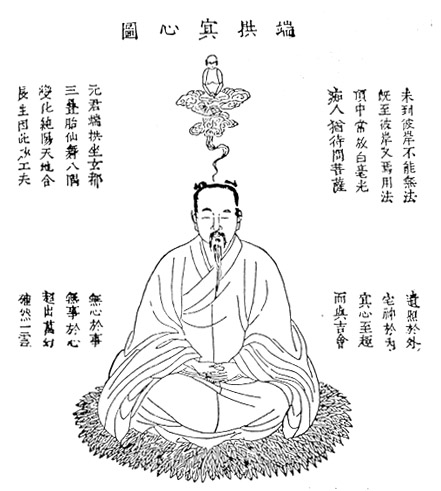
At some point, however, I came across two authors who shed some light on the subject and also seemed to speak from the authenticity of their own experience, which rekindled my interest and made me think that perhaps there was more to it than I had previously realized. These two authors were the late Gopi Krishna, and the contemporary author, J.J. Semple. Through Semple’s books and his website, I discovered an old Chinese Taoist meditation manual, The Secret of the Golden Flower, often described as “Zen with details” (pictured right above & henceforth abbreviated as SGF), together which served to point me in a methodological direction.
The Method
Above all, I wanted to find a clean method — one as free from unscientific baggage as possible. Zazen seemed to afford this, so I took a free introductory class my local Zen Center, which, while it didn’t give me anything I couldn’t have gained with a few online searches, helped me feel like I was at least adhering to some kind of acceptable standard. Taken together with the SGF, Semple's, and Gopi Krishna’s books, I felt I had a good starting point. After a period of adjustment, I settled on a practice that worked well for me; it is as follows:
1. Determine the best hour of the day for you to sit
This is actually very important, as the timing of your sit can make or break it. Two requirements are important here:
The reason for these two caveats is that your metabolism and heart rate are affected by digestion and even mild stimulants or depressants, to the point that you will not be able to manually slow down your metabolism, which in turn will prevent you from meditating properly. This can be tricky to fit into your schedule depending on whether you are a morning person or not.
Morning, Noon, or Night?
This author is most certainly not a morning person, but despite that, I tried several morning time slots without much luck before ultimately settling on meditating in the early evening hours shortly after coming home from work. In the morning I found I was simply too groggy to focus — I would start to fall asleep and I couldn’t control it. I tried other times as well, but found that both after dinner and before bed were non-starters because I was either too full or too tired. I found out very quickly that sitting with a full stomach or when exhaustively tired is mostly a waste of time. You can’t slow down your metabolism and you never enter the meditative state; you’d be better off taking a nap!
1. Determine the best hour of the day for you to sit
This is actually very important, as the timing of your sit can make or break it. Two requirements are important here:
- The hour of time should be before a meal.
- It should be more than 4 to 6 hours after consuming any kind of heart-rate-altering chemical like alcohol, caffeine (including chocolate), sugar (although a little sugar is probably fine), or nicotine.
The reason for these two caveats is that your metabolism and heart rate are affected by digestion and even mild stimulants or depressants, to the point that you will not be able to manually slow down your metabolism, which in turn will prevent you from meditating properly. This can be tricky to fit into your schedule depending on whether you are a morning person or not.
Morning, Noon, or Night?
Thus, 6 or 7 pm pre-dinner ended up being the best time for me, although I found I had to eat a late-ish lunch in order to not be bothered by hunger. Drinking a small glass of milk or vegetable juice helped take the edge off.
2. Find a place that is as free from distraction as possible
In my case, this was my bedroom. Here, I could close the doors and windows, pull the shades, dim the lights, and apart from occasionally noisy neighbors, be more or less protected from unwanted distraction.
 3. Find a sitting position in which you can be more or less comfortable for an hour
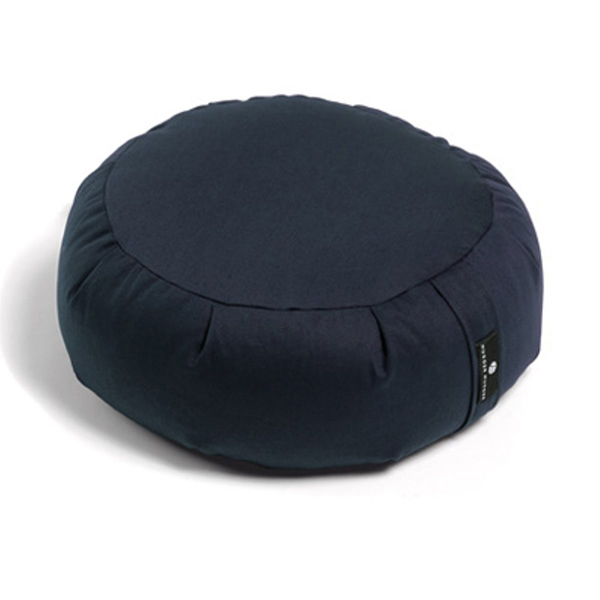
Reclining is generally a bad idea because your body associates it with going to sleep, and you will find it difficult to stay awake. Standing doesn’t really work because you tend to need to shift on your legs occasionally in order to keep them from aching, and this means the best alternative is to sit. After trying to sit on a bed pillow, then two bed pillows, and finally a couch seat-cushion, I caved in and bought a zafu cushion, which worked remarkably well, elevating my legs high enough for them to be completely comfortable (after about a week of acclimation) during long sits. I also draped a quilt over my legs and feet which helped to keep them warm. Sitting in a chair is an option, and although I never tried it personally during this challenge, it seems like it might work if sitting cross-legged is uncomfortable for you.
4. Focus on your breathing
This is one thing that people always tell you to do while meditating, but nobody ever really explains why it’s so important. Well, it turns out that the reason is simply because when you are focusing on your breathing, it distracts your brain from generating other thoughts, and this helps still the mind. It’s especially useful when you’re just starting out, because initially, wrangling your mind into stillness is quite challenging and can seem futile at times — but by remembering to return your focus back to the regular, calming rising and falling of your breathing, your brain will eventually settle.
Position
With your back comfortably — but not forcibly —straightened, either close your eyes or lower them such that they are about the same angle as the tip of your nose (but don’t actually look at the tip of your nose — this would make you cross-eyed.) Again it’s only important insomuch as it reduces the amount of incoming stimuli to your brain. For the first 60 days, I sat with eyes closed, which helped prevent distraction, but also made it easier to unconsciously slip into a daydream if I was not diligently focused. After about 60 days, it became easier to keep my eyes open. You can do whatever works best for you.

Leg Style
Leg style is something people tend to get hung up on, but it’s best to remember that the goal here is not to master asana poses, but to be able to sit comfortably for extended periods of time. This means it’s okay if you are inflexible or weigh more than the average person — you can still meditate, you just need to find which zafu / chair / leg positions combination is most comfortable. Initially, I found the most comfortable position was actually the typically cross-legged “Indian-style” that most of us are familiar with. However, this was only good for around 20 minutes or so, after which it put undue pressure on my ankles. After a few days I switched to “half-lotus” (pictured) which is the same thing as Indian style but with one leg (any leg) pulled up and over such that it rests on the opposite knee or thigh, or within the space created by the kink in the knee.
I never “graduated” to full-lotus, nor do I think anyone needs to, unless they try it and find it’s comfortable. I’ve never been very flexible: it's up to you to find what works best. Remember that the goal is comfort over long spans of time, so you don't need to overachieve.

5. Be patient as your back and leg muscles acclimate to this new position
This will take a few sits, mainly because this is not a position people normally find themselves in. Your lower back muscles ache after 20 minutes or so, and your legs and knees may fall asleep or be uncomfortable.
Whenever you feel uncomfortable during a sit, it’s best to extend your legs or stand up / lay down if you need to. It may not feel like it at first, but in time — trust me — you’ll be completely comfortable, it takes a few days for your muscles and joints to adjust. If, after a week or two on a zafu, your knees or ankles are still sore or your legs are falling asleep, try sitting in a chair rather than sitting cross-legged. You could also try leaning against a bed or couch or some surface which will offer back support. Finally, if you don't have a zafu, you really should get one — the firmness of the zafu will give your legs a degree of comfort that can’t be found in a pillow or couch cushion. Your legs should never fall asleep — a friend of mine who did a 30-day sit complained even during the later days that his legs consistently fell asleep, and it turned out he had been sitting on a pillow. Do yourself a favor and buy a zafu early on.
 6. Consciously stop your mind from following the thoughts it creates
This is the keystone of most meditative practice, and I found that while initially difficult, with even a small amount of practice it was quickly achievable. Its difficulty is due to the fact that the mind inherently avoids stillness, and at first, to “think of nothing” seems impossible — surely even the act of not thinking involves some thinking? Fortunately there is no paradox and “not thinking,” I can assure you, is completely possible for any person, it only takes practice. The critical distinction I finally made was in recognizing the difference between perceiving thoughts, which is a passive process, versus creating them. They are typically very closely bound, such that every perceived thought creates new thoughts, and so on indefinitely, to the extent that even as we sleep, our brain is repeating this process in dreams. The only time it doesn’t is when we are in deep sleep, but our perception is turned off then as well, which draws one to the remarkable conclusion that outside of meditation, we might only experience a thoughtless state of mind for moments in a lifetime, however in meditation we experience it for as long as we like.
A Unique State of Mind
The above struck me because it means that the state you reach in meditation really is a genuinely unique state of mind, and once I got to the deeper states, I realized how true this was. In those states, you can clearly sense that you are in a different mental world, and you can remain there for as long as you like, at least until your legs get tired or, say, your downstairs neighbors start vocally expressing their affections for one another, for example.
As you persist, you’ll notice that your mind comes to rest very naturally if, for as long as 30 minutes, you don’t follow the thoughts or feelings that constantly arise. Those 30 minutes will seem like 300, and it will typically start with a lot of "Oops, I just realized I was daydreaming again" and "Crap, I just reviewed an event from work in my head," until you remember to come back to your breathing — this is the "hack" that will distract your mind from itself long enough for it to settle, and once it’s settled, it's much, much easier for it to stay settled, but until you get there, it can be painfully difficult. It’s also not as gradual a process as one might imagine — it’s a stair-step graph where for 25 minutes or longer you simply will not notice any change, and then, at a certain point, you notice that you’re not where you were before.
 The image that came to mind when I first got the hang of it was that of the brain as a large jug of water. Your thoughts and feelings behave like waves that travel through it, so when you think about something or submerge yourself in a feeling, you are agitating the jug, which creates waves, and so on. This process is very, very subtle because your brain is sensitive even to the quietest of thoughts, and once you create one, the waves will bounce around your brain for several moments until they settle. But, as soon as you stop creating new waves — just as the jug of water would naturally settle and become calm — so too does your mind, except that while the jug might take only a few seconds to settle, your brain tends to take 30-45 minutes. It’s a sensitive instrument, after all.
Amusingly enough, during this initial "waiting period," I always thought to myself — even at the 100th day — “It isn’t working this time, why I am I sitting here? I could be doing something else right now!” ...and so on and so forth. Nevertheless, after the 30-45 minute mark, I would slip into what I began calling The Deep.
 The Deep
The Deep is a point at which you realize that not only has your mind settled, but you’ve entered into another mental state entirely. From a physical perspective, it could be the point at which your brainwaves actually shift to a lower-frequency state — at least, that’s what it feels like. Its hallmark is stillness — to the point where you feel as though you are suspended underwater. I didn't always get there, and it took several weeks before I was even able to approach it, but before long, getting there became the goal of every sit. It made the experience rewarding and fascinating, because I sensed a progression; that I could go further.
Breathing and heart rate were key. I had to slow my breathing — never to the the point of discomfort, mind you — and in doing so, very gradually, my heart rate would slow down. If I ate a heavy meal or was tired, I never got there, but every time I did, it felt good at a deep level. Every time I came out of The Deep, I experienced, for lack of a better word, a blissful, tranquil euphoria that lasted several hours and was the principal benefit of practice. Knowing that I can be in that state if I want to helps me deal with the stresses of everyday life.
7. Repeat
Adhering to the regimen and not “breaking the chain” was challenging, but rewarding. Knowing that I absolutely needed to be home between 6-7 pm every day or I wouldn’t get my sit in put a framework around my day’s activities and motivated me to get work done. It also changed my social life, for better or for worse; for example, one thing I could no longer do was go out for happy hour drinks following work — or rather, the few times I tried to go to a bar and not drink made me feel like it wasn’t worth the effort. It was interesting to find that I really didn’t care for socializing unless I was drinking, and that drunk people can be really obnoxious to be around when you’re stone-sober. Furthermore, knowing that meditation would require a certain amount of energy, I found myself moderating my work level during the day, such that I didn’t end up completely worn-out.
Coming soon: The results!
In my case, this was my bedroom. Here, I could close the doors and windows, pull the shades, dim the lights, and apart from occasionally noisy neighbors, be more or less protected from unwanted distraction.
3. Find a sitting position in which you can be more or less comfortable for an hourReclining is generally a bad idea because your body associates it with going to sleep, and you will find it difficult to stay awake. Standing doesn’t really work because you tend to need to shift on your legs occasionally in order to keep them from aching, and this means the best alternative is to sit. After trying to sit on a bed pillow, then two bed pillows, and finally a couch seat-cushion, I caved in and bought a zafu cushion, which worked remarkably well, elevating my legs high enough for them to be completely comfortable (after about a week of acclimation) during long sits. I also draped a quilt over my legs and feet which helped to keep them warm. Sitting in a chair is an option, and although I never tried it personally during this challenge, it seems like it might work if sitting cross-legged is uncomfortable for you.
4. Focus on your breathing
This is one thing that people always tell you to do while meditating, but nobody ever really explains why it’s so important. Well, it turns out that the reason is simply because when you are focusing on your breathing, it distracts your brain from generating other thoughts, and this helps still the mind. It’s especially useful when you’re just starting out, because initially, wrangling your mind into stillness is quite challenging and can seem futile at times — but by remembering to return your focus back to the regular, calming rising and falling of your breathing, your brain will eventually settle.
Position
With your back comfortably — but not forcibly —straightened, either close your eyes or lower them such that they are about the same angle as the tip of your nose (but don’t actually look at the tip of your nose — this would make you cross-eyed.) Again it’s only important insomuch as it reduces the amount of incoming stimuli to your brain. For the first 60 days, I sat with eyes closed, which helped prevent distraction, but also made it easier to unconsciously slip into a daydream if I was not diligently focused. After about 60 days, it became easier to keep my eyes open. You can do whatever works best for you.
Leg Style
Leg style is something people tend to get hung up on, but it’s best to remember that the goal here is not to master asana poses, but to be able to sit comfortably for extended periods of time. This means it’s okay if you are inflexible or weigh more than the average person — you can still meditate, you just need to find which zafu / chair / leg positions combination is most comfortable. Initially, I found the most comfortable position was actually the typically cross-legged “Indian-style” that most of us are familiar with. However, this was only good for around 20 minutes or so, after which it put undue pressure on my ankles. After a few days I switched to “half-lotus” (pictured) which is the same thing as Indian style but with one leg (any leg) pulled up and over such that it rests on the opposite knee or thigh, or within the space created by the kink in the knee.
I never “graduated” to full-lotus, nor do I think anyone needs to, unless they try it and find it’s comfortable. I’ve never been very flexible: it's up to you to find what works best. Remember that the goal is comfort over long spans of time, so you don't need to overachieve.
5. Be patient as your back and leg muscles acclimate to this new position
This will take a few sits, mainly because this is not a position people normally find themselves in. Your lower back muscles ache after 20 minutes or so, and your legs and knees may fall asleep or be uncomfortable.
Whenever you feel uncomfortable during a sit, it’s best to extend your legs or stand up / lay down if you need to. It may not feel like it at first, but in time — trust me — you’ll be completely comfortable, it takes a few days for your muscles and joints to adjust. If, after a week or two on a zafu, your knees or ankles are still sore or your legs are falling asleep, try sitting in a chair rather than sitting cross-legged. You could also try leaning against a bed or couch or some surface which will offer back support. Finally, if you don't have a zafu, you really should get one — the firmness of the zafu will give your legs a degree of comfort that can’t be found in a pillow or couch cushion. Your legs should never fall asleep — a friend of mine who did a 30-day sit complained even during the later days that his legs consistently fell asleep, and it turned out he had been sitting on a pillow. Do yourself a favor and buy a zafu early on.
6. Consciously stop your mind from following the thoughts it createsThis is the keystone of most meditative practice, and I found that while initially difficult, with even a small amount of practice it was quickly achievable. Its difficulty is due to the fact that the mind inherently avoids stillness, and at first, to “think of nothing” seems impossible — surely even the act of not thinking involves some thinking? Fortunately there is no paradox and “not thinking,” I can assure you, is completely possible for any person, it only takes practice. The critical distinction I finally made was in recognizing the difference between perceiving thoughts, which is a passive process, versus creating them. They are typically very closely bound, such that every perceived thought creates new thoughts, and so on indefinitely, to the extent that even as we sleep, our brain is repeating this process in dreams. The only time it doesn’t is when we are in deep sleep, but our perception is turned off then as well, which draws one to the remarkable conclusion that outside of meditation, we might only experience a thoughtless state of mind for moments in a lifetime, however in meditation we experience it for as long as we like.
A Unique State of Mind
The above struck me because it means that the state you reach in meditation really is a genuinely unique state of mind, and once I got to the deeper states, I realized how true this was. In those states, you can clearly sense that you are in a different mental world, and you can remain there for as long as you like, at least until your legs get tired or, say, your downstairs neighbors start vocally expressing their affections for one another, for example.
As you persist, you’ll notice that your mind comes to rest very naturally if, for as long as 30 minutes, you don’t follow the thoughts or feelings that constantly arise. Those 30 minutes will seem like 300, and it will typically start with a lot of "Oops, I just realized I was daydreaming again" and "Crap, I just reviewed an event from work in my head," until you remember to come back to your breathing — this is the "hack" that will distract your mind from itself long enough for it to settle, and once it’s settled, it's much, much easier for it to stay settled, but until you get there, it can be painfully difficult. It’s also not as gradual a process as one might imagine — it’s a stair-step graph where for 25 minutes or longer you simply will not notice any change, and then, at a certain point, you notice that you’re not where you were before.
The image that came to mind when I first got the hang of it was that of the brain as a large jug of water. Your thoughts and feelings behave like waves that travel through it, so when you think about something or submerge yourself in a feeling, you are agitating the jug, which creates waves, and so on. This process is very, very subtle because your brain is sensitive even to the quietest of thoughts, and once you create one, the waves will bounce around your brain for several moments until they settle. But, as soon as you stop creating new waves — just as the jug of water would naturally settle and become calm — so too does your mind, except that while the jug might take only a few seconds to settle, your brain tends to take 30-45 minutes. It’s a sensitive instrument, after all.Amusingly enough, during this initial "waiting period," I always thought to myself — even at the 100th day — “It isn’t working this time, why I am I sitting here? I could be doing something else right now!” ...and so on and so forth. Nevertheless, after the 30-45 minute mark, I would slip into what I began calling The Deep.
The DeepThe Deep is a point at which you realize that not only has your mind settled, but you’ve entered into another mental state entirely. From a physical perspective, it could be the point at which your brainwaves actually shift to a lower-frequency state — at least, that’s what it feels like. Its hallmark is stillness — to the point where you feel as though you are suspended underwater. I didn't always get there, and it took several weeks before I was even able to approach it, but before long, getting there became the goal of every sit. It made the experience rewarding and fascinating, because I sensed a progression; that I could go further.
Breathing and heart rate were key. I had to slow my breathing — never to the the point of discomfort, mind you — and in doing so, very gradually, my heart rate would slow down. If I ate a heavy meal or was tired, I never got there, but every time I did, it felt good at a deep level. Every time I came out of The Deep, I experienced, for lack of a better word, a blissful, tranquil euphoria that lasted several hours and was the principal benefit of practice. Knowing that I can be in that state if I want to helps me deal with the stresses of everyday life.
7. Repeat
Adhering to the regimen and not “breaking the chain” was challenging, but rewarding. Knowing that I absolutely needed to be home between 6-7 pm every day or I wouldn’t get my sit in put a framework around my day’s activities and motivated me to get work done. It also changed my social life, for better or for worse; for example, one thing I could no longer do was go out for happy hour drinks following work — or rather, the few times I tried to go to a bar and not drink made me feel like it wasn’t worth the effort. It was interesting to find that I really didn’t care for socializing unless I was drinking, and that drunk people can be really obnoxious to be around when you’re stone-sober. Furthermore, knowing that meditation would require a certain amount of energy, I found myself moderating my work level during the day, such that I didn’t end up completely worn-out.
Coming soon: The results!


