Krishnamurti used to begin his talks by describing the terrible state the world was in: war, famine, refugee crises, negative emotion, and blind politicians profiting from the suffering. Krishnamurti’s dead, and nothing much has changed. There’s turmoil in Europe with Brexit, the Euro crisis, and there’s conflict in America with the forthcoming election. The aftershocks of these crises affect people all over the world.
Was Krishnamurti stupid in saying that an inner transformation has anything to do with, let alone could change, world conditions? Is Samadhi simply escapism?
Awakened Kundalini perfects the brain and balances the body. Kundalini also clarifies personal relationships and intensifies energy in the immediate surrounding reality of work and social life. But how far this surrounding reality reaches is a moot point. Whether Kundalini has anything to do with facing up to the horrors of the modern world is an open question. The Blissful Inner Heat is blissful when it’s inner, but can become a delirium when applied it to the state of the larger world. I have a deep admiration for people who are activists and manage to maintain their integrity, but is it really possible to awaken Kundalini and run things, make larger decisions?
There is an alchemical motto: "The All, The One." The fact that there is an energy continuum is becoming more and more obvious. Therefore an individual’s inner action can affect everything. But this realisation, while true, can easily lapse into a Tolkienesque fantasy world of good wizards vs. bad wizards, of the goodies behind the scenes warring with the baddies out front. In order not to fall into this fantasy trap, the individual, the little one must become the "One, The All." In other words, blustering politicians and corrupt businessmen as well as the suffering victims of war and famine are all me. They’re inside me. It’s no wonder Krishnamurti died saying that he’d failed. The Awakening he spoke of has perhaps only ever been achieved by Sakhyamuni, the Buddha...if at all.
If transcendental and non-human forces lie behind, and form, the manifest world, then the politicians and warmongers are as much "the sons and daughters of Eternity," to use Blake’s phrase, as are those who are seeking Truth. We are in the Kali Yuga big time.
So what, then, is Kundalini? She is physical, powerful, white hot. Is She also "consciousness," in some higher form or other? Consciousness is certainly the starting point, a conscious act of sitting down to meditate and become free. In the Buddha’s original teaching, consciousness, too, is one of the five strands of the "five fold stem of illusion." Another of these illusions is "personality" (even the loudest politician’s!). It’s a daunting truth, but perhaps, behind even consciousness and personality (i.e., in an apparent eternal darkness) there is "panna," — "prajna" in Sanskrit — wisdom. Wisdom is not confined by consciousness, which is why, when Kundalini awakens, she’s as physical as the hand in front of my face. And perhaps, on a quantum level, where sub-atomic particles share knowledge, it’s this "panna," "prajna" or non-conscious wisdom that is the ultimate constituent of Kundalini.
In the last few posts, I have attempted to explain the different kinds of yoga practices for achieving union with the absolute. The series began with an explanation of Integral Yoga and a deeper analysis of the different forms of yoga that can be integrated into our daily practice, namely Jnana Yoga, Karma Yoga and Bhakti Yoga. This is the final post in the Yoga series.
As mentioned here, awakening kundalini can be a trigger for an ecstatic experience, a brief glimpse of the absolute when the mental barriers of limited individuality fall away temporarily. All spiritual methods are different ways of stilling the mind to get back to that state of emptiness. As defined by Patanjali, Cessation of the mind is Yoga. Probably the most simple and elegant definition of Yoga. When the mind stops, reality is experienced. The ego, a collection of selective memories that form our self-image, our ideas about social status and our place in that hierarchy, are all mental projections. Once they drop, along with the constant mental chatter, Yoga is achieved.
I have been asked about methods for awakening the kundalini and these last few posts are my attempt to answer those questions. I personally awakened mine accidentally, without following a set of practices. However, the awakening leads to insights about the nature of the mind and how one attains the state of emptiness or samadhi. A kundalini awakening takes the mind out of its conditioned state and returns it to a state of child-like innocence, receptive to divine grace.
Awakening kundalini is not in our hands entirely; Karma is an essential factor in the equation. Although not everyone is chosen to receive this blessing, no one is excluded from putting practices in place to create the right circumstances for an awakening.
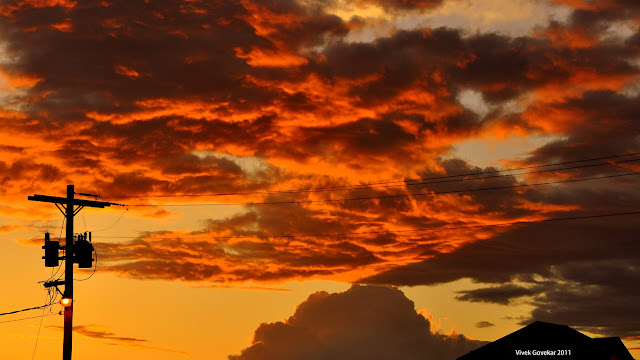 |
| The Heavens |
By practicing methods that ingrain positive habits, you allow illusions to drop, the mind to cease, karmic loops to close. An intellectual understanding of the process will not achieve this. If the power of all your actions and thoughts is harnessed and directed towards an awakening, only then can you make progress. It's the purpose of Integral Yoga. Regardless of whether these practices culminate in a kundalini awakening or not, the methods will help you achieve inner peace, release stress and create a balanced, better adjusted human being.
There is significant overlap in all these methods. Choosing the right action requires mindful awareness. It combines Karma Yoga and Jnana Yoga. Surrender to the divine, knowing that each action is an offering to Him allows me to work at my passion with total devotion. When I take a photograph, I become one with that moment. I am completely absorbed in that moment of zen where the object, the observer and the act of taking the photograph are one indivisible whole. The devotion to the task at hand IS devotion to the almighty. This is both Bhakti Yoga and Karma Yoga. This is the goal behind the practice of Integral Yoga. To bring the mind to a stillness, to realize the union with the absolute that already exists, using every action, every thought, every moment in the service of this goal.
Once these practices are put in place, every action achieves a greater significance. Nothing is mundane. Everything is sacred. Every day is a holy day. Naturally, one elevates his or her vibration. Life is seen with a feeling of awe. It is lived as art, as poetry. Each moment is lived for its own sake, knowing that each moment carries the potential for samadhi, for union with the absolute.
The ego-driven human being is a jumble of contradictions, frustrations and misery. The misery comes from pursuing fantasies. Buy this car and it will make you happy. Drink this beer and you will be attractive to women. Oh, you MUST buy this phone if you want to hang with the "in crowd," scream the commercials.
The ego responds, luring you further and further into illusion, away from the stillness within. Happiness is not outside. It is within. Craving breeds more craving. Each material acquisition only whets the appetite for more. Once you fulfill your desire, you are happy for one moment, before once again craving the next shiny object. Mindfulness makes you aware of the incessant craving and the underlying misery. This awareness rises, the more you observe each moment, the more you meditate. The less you are affected by external temptations, the less stress, misery and frustration you accumulate.
 |
| Barriers |
So far, in these posts, I have talked about Yoga without a single mention of asanas or poses — most people's definition of Yoga. Raja Yoga addresses that. Commonly, the asanas or poses are performed for health reasons, rendering you fit and free from disease.
However, the real purpose of performing the poses, as I discovered after my awakening, is getting the body ready once kundalini awakens. The kriyas that occur afterwards are involuntary and require a limber body, able to perform difficult postures as the energy clears blockages. Being unable to bend and stretch as needed is very painful and potentially damaging to the body.
In fact, all three practices: breath control, poses and meditation are equally important in preparing for an awakening:
- Not knowing the proper breathing exercises prevents the release of blockages in a safe and efficient manner.
- Being in good shape, as opposed to being over-weight, out of shape and reluctant to perform physical exercise, is crucial to avoiding disaster during or after awakening.
- Performing only
the poses may make you extremely fit, but your mind will not be ready
for the trauma an awakening brings. Being a meditator with an unfit body
may allow you to cope with the psychic challenges associated with states
of higher vibration, but the body needs conditioning to avoid the agony
of bending into difficult poses. That's why working all three together is necessary.
Raja Yoga cultivates this by preparing the body and mind in a systematic fashion so one can ease into an awakening gently.
If there is a lot of accumulated trauma and negative karma for the energy to clear, if the ego has been inflated and deluded, additional barriers and mental torment must be overcome when the clearing begins. My "spontaneous awakening" gave me a chance to realize why each one of the practices is important, albeit, as I was not prepared, I learned the hard way. A very negative and agonizing way.
As the energy passed through me, I spent many hours writhing and contorting in the wheel pose
and other physically challenging poses. I have always been physically
fit, am a bodybuilder, golfer and martial artist. I even dabbled in
yoga. Still, I was NOT completely prepared for the shock of involuntary kriyas. I had to get in better shape to withstand the onslaught.
The eight-fold path of Raja Yoga or "The Royal path to Yoga" consists of eight steps:
- Yamas (Abstentions): Ahimsa (non-injury), Satya (truth), Asteya
(non-stealing), Brahmacharya (chastity), Apragraha (non-greed).
- Niyamas (Moral Observations): Shaucha (purity), Santosha (contentment),
Tapas (austerity), Svadhyaya (study of the scriptures), Ishvara
Pranidhana (surrender to God).
- Asana: Steady pose, posture or seat. Yogic poses.
- Pranayama: control of vital energy through breathwork.
- Pratyahara: Withdrawal of the senses.
- Dharana: concentration of the mind.
- Dhyana: Meditation.
- Samadhi: Enlightenment, union with the Divine.
We can divide these into three categories. In a category by itself is Samadhi, the seeker's final goal, achieved through practices that awaken the kundalini. The other practices, therefore, fall under two categories, preparatory and causative.
Of the eight steps, the first two, Yama and Niyama, can be termed preparatory. In and of themselves, they are insufficient to trigger a kundalini awakening. Yamas overlap with methods mentioned in my post on Karma Yoga. These practices tie up karmic loose ends and prevent the creation of new negative karma impeding spiritual progress. Niyamas overlap with Jnana Yoga and Bhakti Yoga, creating a mental state conducive to divine grace: dropping illusions, studying scripture and creating positive patterns in the brain, staying in a positive and ego-free mental state.
Steps 3 through 7 are termed causative. These practices may trigger a kundalini awakening as you perform them, provided your karma allows for it.
Asana: There are several cases of yogis awakening kundalini due to a regular practice of physical yoga poses. We can add tantric sexual practices, martial arts such as Tai Chi and Aikido to this list of physical practices that may cause an awakening.
Pranayama: JJ Semple awakened his kundalini through a practice of breathwork. He has described it in his wonderful book, Deciphering the Golden Flower One Secret at a Time. Whether it is traditional practices of pranayama described in ancient texts or newer methods of breath control, this is a powerful trigger for an awakening.
Steps 5, 6 and 7 can be grouped together into one easy to understand term: Meditation. Gopi Krishna awakened his kundalini during meditation. Several others have awakened it during some form of mental concentration or visualization practice.
A regular practice of any one of the causative steps of Raja Yoga may be enough to trigger an awakening. All three performed systematically, along with the preparatory steps increases your chances and more important, removes obstacles and potential hindrances once the energy is awakened and starts its work. A systematic overhaul of the ego-mind and body codified in a step-by-step set of instructions. Hence its designation as the Royal path.
To reinforce my earlier statements and what JJ Semple wrote in his previous blog post, a kundalini awakening is not a paint-by-numbers activity like learning to drive a car. Follow instructions, perform the necessary steps, and boom, awakening ensues. Sorry. Ain't gonna happen. Expectation leads to disappointment. The better approach is to perform each step for its own sake, expecting only to uncover more and more of one's true self, a transformation into a healthier individual, both mentally and physically, better balanced and capable of living each moment in a state of contentment and inner peace. As a bonus, you may receive a kundalini awakening. Craving an outcome will almost guarantee you will not awaken anything because it is the craving and the competitive ego that causes craving needs to be eliminated in order to receive an awakening.
This completes my Yoga series of blog posts. I hope that this has been a helpful series.

 Awakened Kundalini perfects the brain and balances the body. Kundalini also clarifies personal relationships and intensifies energy in the immediate surrounding reality of work and social life. But how far this surrounding reality reaches is a moot point. Whether Kundalini has anything to do with facing up to the horrors of the modern world is an open question. The Blissful Inner Heat is blissful when it’s inner, but can become a delirium when applied it to the state of the larger world. I have a deep admiration for people who are activists and manage to maintain their integrity, but is it really possible to awaken Kundalini and run things, make larger decisions?


