Showing posts with label Kundalini. Show all posts

Sunday, April 3, 2022

Kundalini Pain and Headache

I recently had a consultation with JJ Semple and got invited to write about my kundalini process for this blog. First of all, I want to express my gratitude for this invitation.

I am not an experienced BFM practitioner and the even less familiar with any structured method of kundalini awakening.

Yet, my hope is that the questions, challenges, and obstacles that I experience in my personal process might  relate to others, so that we can  share practical research on the obstacles and challenges we encounter on our various paths.

A few words about myself: I am female, 35, living close to Berlin, Germany, in natural suuroundings. I am an author and bodyworker, focusing my research on embodiment, sexuality, health, mysticism and collective traumahealing.

Ilan Stephani

I had come across books about kundalini years ago, but I did not pay attention to this phenomenon until I experienced a series of violent, unexpected kundalini sensations.

Now, finally, I am focusing on a safe and sustainable approach to awakening kundalini.

The first topic I want to explore is the pain in the spine caused by kundalini activity, especially pain in the most upper part of the spine, around the skull joint.

All of my unexpected kundalini shocks had this one thing in common: a sharp pain in and around my skull joint, accompanied by headaches and contractions in my jaw.

From the first time onward, I was aware that this part of my body ached during kundalini activity because it was chronically tense and contracted. So far, I have not been able to release it in a methodical and sustainable way before experiencing another crisis.

When I checked with JJ Semple on this, he mentioned a contemporary dentist whose treatment for those blockages, uses Cone Beam tomography and a special oral device to reconfigure the airway chambers in the neck, skull, mouth, jaw, and head correctly.

JJ Semple mentioned that this treatment also resolves deep-seated unconscious breathing issues. Overall health is restored and crucial nerves and energies are able to circulate through the upper spine more easily, without chronic stress, friction, or pain.

While discussing this information with JJ Semple, I was reminded of a German method that I had studied years ago—CANTIENICA®.

As you can see on their website, the method does not address kundalini, it focuses on pelvic floor training, posture, effortless running, etc. Nevertheless, it's a process that might help me with kundalini.

I have only studied the pelvic floor module and have not practiced it in quite a while. Yet, in a sense, I "embody" its basic principles so I am curious about how it might affect kundalini related issues.

The method reactivates and trains the inner layer of muscles in the body, the so-called autochthonous muscles that are normally function in the background beyond our consciousness and, therefore, do not get used in our cultural postures and habits. So, once again, as is the case of kundlaini, we are unaware of the dormant resources in our beings. And if the rise in breathing-related conditions such as, COPD, asthma, infections like influenza, the deviated septum, pneumonia and tuberculosis, anatomical irregularities like malocclusion, sinus, allergies, and even lung cancer are any indication, it's getting worse all th time.

It is as if we've been asleep and have not begun to wake up.

"Every joint and every bone is meant to have its place and have space. Your body can and even wants to provide space for every joint and bone, there does not need to be any friction or contraction." These are typical CANTIENICA® guidelines.

Since Benita Cantieni, the founder, cured her skoliosis with this work, it is used widely for recovery, dealing with back pain, knee pain, etc.

I managed to find some illustrations for this bodywork, the lengthening of the spine and the engagement of the autochthonous muscles here (sorry, text only in German). You can clearly see how the vision of a totally straight spine etc differs from our cultural norm of internal collapse.

With JJ Semple's hint in mind, I re-opened my books and looked for parallels to the challenges of preparing the nervous system on a more physiological level, the down to earth space that nerve channels utilize while the body is experiencing kundalini activity.

Indeed, I found a chapter in a German book where the CANTIENICA® founder describes how she sensed and intentionally moved one of the key bones of the skull (Os Sphenoidale).

She has developped a module for moving the muscles and structures around the face and skull, but as far as I could tell, this faceforming module focuses on creating a younger face and removing wrinkles.

It does not work directly with the cerebral nerves in "creating more space for every fibre, no matter where."

However, the founder´s writing about her discovery with the Os Sphenoidale is what encouraged me to transfer some principles of the method in order to focus more precisely on all those structures around my skull joint.

I will describe briefly what my practice looks like. However, I have clearly benefited from my past studies in the pelvic floor module of the method, as I am already familiar with the basic postures and inner pulsing of the autochthonous muscles.

There is a lot of instruction available for free on the website and the internet.

Here are some free basic video instructions, and I think there is more out there:

You might also find something in this workout list.* *

*Of course there is zero business connection between me and this method, I'm just sharing my research.

**I also ask myself if this method could help in terms of bodily symmetry and in releasing other pain centers in the body. For sure, this is only a thesis at the moment and requires much more research and testing.

So, before I dive into diaphragmatic breathing itself, my current "warmup practice" looks like this:

I sit down and look at the details of an anatomical model of a skull, trying to embody more of its amazing complexity and learning to sense it inside. I put special focus on the upper vertebrae and the anatomy of the cerebral nerves and blood vessels running through the basic opening of the skull.
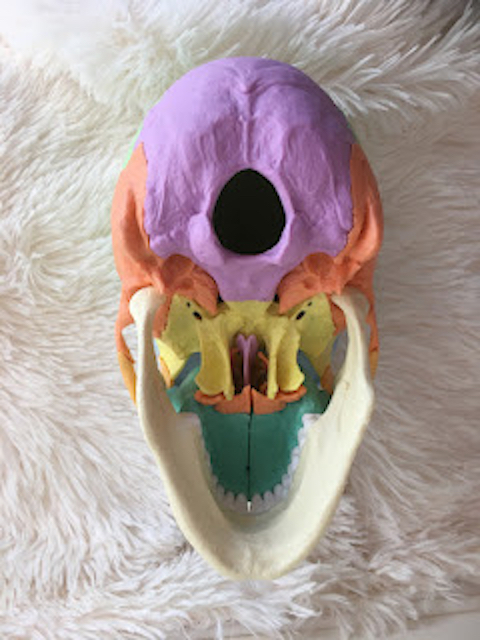
POV: Human Skull from bottom

I then align my body with the lengthened spine, opening the joints along the spine by pulsing with the autochthonous muscles fibres (typical CANTIENICA® stuff as presented in the links above) and engage from there with the bones and structures of my skull joint.

I imagine different lines through my skull on the base level of my brain, mostly diagonal ones - and open the space in between in rhythmical pulses. I transfer the method´s principle of pulsing with inner muscles to pulsing with nerve fibres, as well, and simply stretch the length of internal lines in a rhythmical manner.

Of course, there are infinite possibilities for lines in this complexity, i.e., from my front teeth to the back of my mouth, etc. So I make some up to see how it feels.

To some extent, this is "faking it until I am making it," but I do sense that my body gets more familiar with this practice and becomes capable of moving these structures.

I also notice that my body calls me to focus on other areas around my head, i.e., the bones of my paranasal sinuses and eyes. This is especially fascinating because it causes a direct release in my breathing patterns that I was not even aware of—the fact that my breath was blocked before.

Due to this practice, my breathing now flows easier and with less noise. I also sense that I am breathing more efficiently, not needing the same amount of air for the same amount of energy. And it feels incredibly good and right in my paranasal sinuses, jaw and skull joint. I often fall into waves of release with yawning, tears and trembling.

It excites me because diaphragmatic deep breathing is such a strong parallel to the topic that the contemporary dentist focuses on. I will keep practicing and experimenting to see how it develops.

Of course, there is an infinite amount of new questions arising from this.

Could working on one's own come close to what the dentist is able to do in a body, actually changing the configuration of the breathing chamber? I have no clue.

Will this practice reduce the pain I experience during future kundalini activity? I do not know.

Could this body of work help others? I do not know either.

However, it does help me at the moment and it encourages me to keep going. If anything  resonates for you, I would love to stay in touch by exchanging research on this platform.

Monday, October 12, 2020

More Science of Breathing

You’re invited to a foot race. You walk towards the starting line, only to be turned away. The people in charge move you back 30 yards behind the start. You look around. People are scattered all over the track, a large group at the starting line, a few runners twenty yards ahead of the line, one even 30 yards in front, a few standing with you. You turn around and see two runners twenty yards behind you and you say to yourself, “I’m not so bad off after all, now that I see those chumps.”

Footrace - Bilbao, Spain Dec. 20115

A race with people starting from various positions on the course instead of at the starting line is not capricious handicapping, it’s a simplistic metaphor for the breathing issues now plaguing civilization. As noted in the previous episode on the Science of Breathing, debilitating respiratory conditions are multiplying: COPD, asthma, infections like influenza, the deviated septum, pneumonia and tuberculosis, anatomical irregularities like malocclusion, sinus, allergies, and even lung cancer.

This hasn’t always been the case:

“Until the seventeenth century most of the great physicians and anatomists were interested in the respiratory muscles and the mechanics of breathing. Since then, these muscles have been increasingly neglected, lying as they do in a no-man’s land between anatomy and physiology.”
~ Breath - James Nestor, author.

Nevertheless, we’re now saddled with all kinds of maladies derived from breathing through the mouth and eating soft, easy-to-chew foods. Not all of us but a goodly proportion of us. And when we learn about the issue, when it affects us personally, that’s when we find out we’re 30 yards behind the starting line. Way behind.

“Most of us aren’t that sensitive. It’s much more common, especially in the modern world, to never experience full-blown, life-threatening stress, but to never fully relax either. We’ll spend our days half-asleep and nights half-awake, lolling in a gray zone of half-anxiety. When we do, the vagus nerve stays half-stimulated.

“During these times, the organs throughout the body won’t be “shut down,” but will instead be half supported in a state of suspended animation: blood flow will decrease and communication between the organs and the brain will become choppy, like a conversation through a staticky phone line. Our bodies can persist like this for a while; they can keep us alive, but they can’t keep us healthy.”
~ Breath - James Nestor, author.

Everyone breathes differently; some more efficiently than others. The reasons are partly physiological; partly psychological. Historically, the only sources for breathing guidance came from yoga and meditation literature.

“You cannot influence or control the heart rate directly; it’s an autonomic function. So, once again, you use a “handle” to accomplish it — diaphragmatic deep breathing, which, once you master it, makes your breathing more profound and more regular. What do I mean by more profound and regular? Profound means still, as in silent; regular means rhythmic.

“When you extend the belly, pushing it outward on inhalation and then pulling the belly in to expel air, you are embarking on a regimen of abdominal and diaphragmatic calisthenics. Starting this activity for the first time — whether sitting, walking, reclining, or lying down — you may feel a burning sensation. That is the muscles of the abdomen telling you that you are beginning to breathe correctly. Using the belly muscles is like pump priming, that is, using the handle of a pump (the belly) to activate the pump mechanism (the diaphragm).”
 ~ The Golden Flower Meditation website - JJ Semple, author.

Contrast the above with the following excerpt:

“Breathing is an autonomic function we can consciously control. While we can’t simply decide when to slow or speed up our heart or digestion, or to move blood from one organ to another, we can choose how and when to breathe. Willing ourselves to breathe slowly will open up communication along the vagal network and relax us into a parasympathetic state.”
~ Breath - James Nestor, author.

The two orthodoxies — physical science and metaphysical science — are coming together. So how do we get everyone, every breather, to the starting line? Can we wave a magic wand?

James Nestor wrote Breath only after gathering extensive information from a diverse number of sources and then fitting them together in an organized manner. His book offers many solutions, the first of which is to select an assessment procedure to tell you where you are — at the starting line, behind it, or out in front.

Once you have this information you can evaluate the methods for correcting your breathing disorder – the ones your assessment uncovered. The book proffers many of them.
Why should this matter to you? Why is correct breathing so important? You want to do this because correct breathing isn’t confined to only respiratory issues; it’s the key to a healthy body.

“The best way to keep tissues in the body healthy was to mimic the reactions that evolved in early aerobic life on Earth—specifically, to flood our bodies with a constant presence of that “strong electron acceptor”: oxygen. Breathing slow, less, and through the nose balances the levels of respiratory gases in the body and sends the maximum amount of oxygen to the maximum amount of tissues so that our cells have the maximum amount of electron reactivity.

“In every culture and in every medical tradition before ours, healing was accomplished by moving energy,” said Szent-Györgyi. The moving energy of electrons allows living things to stay alive and healthy for as long as possible. The names may have changed—prana, orenda, ch’i, ruah—but the principle has remained the same. Szent-Györgyi apparently took that advice. He died in 1986, at the age of 93.”
~ Breath - James Nestor, author.

Thursday, June 11, 2020

Breathing and Covid-19

Previously, we examined the relationship between foods consumed and the Covid-19 virus. This post examines the effects that kundalini mediation breathing exercises have on the metabolism. Do they fortify it? Do these exercises prepare the body to resist the ravages of Covid-19?

The answer is: nobody knows and there is no way to prove whether it could...at this time.

Sure, you can imagine a clinical experiment where selected groups that have and have not practiced diaphragmatic deep breathing would produce results scientists can measure. We're a long way from being able to do this, both from an organizational and medical standpoint.

 
All we have is extrapolations and anecdotal accounts. Nevertheless, I believe that the Golden Flower Meditation breathing exercises I practice do protect me. Why? Because these exercises are the aerobics for the diaphragm. I have no scientific evidence to support this hypothesis, only the fact that while exercising, I'm able to breathe through the nose without gasping for air.
https://amzn.to/30CGbWv
A few days ago the NPR program Fresh Air featured a Terry Gross interview with James Nestor, a researcher exploring the many aspects of the science and art of breathing:
"You can think about breathing as being in a boat, right? So you can take a bunch of very short, stilted strokes and you're going to get to where you want to go. It's going to take a while, but you'll get there. Or you can take a few very fluid and long strokes and get there so much more efficiently. ... You want to make it very easy for your body to get air, especially if this is an act that we're doing 25,000 times a day. So, by just extending those inhales and exhales, by moving that diaphragm up and down a little more, you can have a profound effect on your blood pressure, on your mental state."
~ How The 'Lost Art' Of Breathing Can Impact Sleep And Resilience
As I listened to this interview, I was struck by how much it echoes the techniques of Golden Flower Meditation:
"When you extend the belly, pushing it outward on inhalation and then pulling the belly in to expel air, you are embarking on a regimen of abdominal and diaphragmatic calisthenics. Starting this activity for the first time — whether sitting, walking, reclining, or lying down — you may feel a burning sensation. That is the muscles of the abdomen telling you that you are beginning to breathe correctly. Using the belly muscles is like pump priming, that is, using the handle of a pump (the belly) to activate the pump mechanism (the diaphragm)."
~ Golden Flower Meditation website - JJ Semple

I've found a few practical things you can use to protect yourself if you're over 70 (remember, the Covid-19 virus is 15% fatal for +80 years):

Early warning: Get an Oximeter. It warns you before the virus symptoms appear.

Diet: Avoid carbohydrates. Deadlier infection rate for those who consume carbohydrates in large quantities.

Breathing exercises: There's no reason NOT to practice some form of yogic breathing exercises, using the diaphragm and the nostrils. The diaphragm is a muscle, just as important as the muscles you exercise in the gym, if not more so. Make sure the diaphragm "participates" in every activity, whether walking, yoga, reclining, exercising, or meditation — breathe through the nostrils as described in the Fresh Air interview cited above.

https://amzn.to/2AfXKAQ
Listen to it. And purchase the book. It's adapted for this day and age. In depth serious research on the lungs, the diaphragm, the nostrils, the configuration of the breathing mechanism, the importance of nasal breathing, and bodily symmetry — a topic I explore in all my books.

Friday, November 1, 2019

Why Didn't Judy Sing Judy?

The creators of the new movie, Judy, made a conscious choice NOT to use her singing voice. Rather they used the voice of their star, Renée Zellweger. That's like using Ronan O'Sullivan Farrow's voice in a Frank Sinatra biopic. God forbid...

What does this have to do with kundalini?  Investigators such as Gopi Krishna have written about the effects of a kundalini awakening, not only on those who meditate for it or those who are spontaneously struck by it, but also as it concerns people of genius, who, they believe, appear to have been born with an operational kundalini. By that I mean the energy centers that ordinary people must cultivate, either on purpose or accidentally, are already functioning at birth in people of genius. As of yet, how this works, no one knows.

https://youtu.be/UFITLxanHoU
“Look For The Silver Lining" - sung by Judy Garland in Till The Clouds Roll By (1946)
These writers have cited Walt Whitman, Einstein, Maurice Bucke, Tennyson, Wordsworth, Goethe, Nietzsche, and Schopenhauer as examples of genius so extraordinary that some advanced aspect of physiological evolution must be at work in their beings that allows them unequaled mastery in their field, combining the ability to focus with special insight into the nature of things. This faculty manifests itself in many ways.

How did they come up with these names? Why the list was restricted to thinkers and philosophers I don't know? Nevertheless, I'd like to broaden the list to include, not only to great intellects, but also writers, athletes, artists, singers and musicians.

No mention is made of how geniuses — of the academic sort — conduct their lives. Whether: they are happily married. Have hobbies. Pay taxes. Have lots of friends. Are moody. Are on good terms with their children. Mistreat their servants. Have an addiction.

The same is not true for the second group — a sample of which I nominate: Willie Mays, Thelonious Monk, Charles Chaplin, Frank Sinatra, Mozart, Edith Piaf, Billie Holiday, Fyodor Mikhailovich Dostoevsky, Aretha Franklin, Stanley Kubrick, and yes, Judy Garland and a select few others. Their celebrity, especially for those who've lived in this era of mass media scrutiny, fed their various urges, co-opting and overwhelming them.

Celebrity  becomes notoriety. Not for all, of course. But genius does not necessarily equate to stability, not for Mozart or Judy. Personal relations and personal affairs are often mismanaged or neglected by geniuses. Still, we wonder at their uniqueness, their one-in-a-million virtuosity. There's a big difference between average and genius. A gaping chasm that director Rupert Goold did not dare to cross. According to Internet commentary, he forced Renée Zellweger to use her own voice because he believed pantomiming and lip syncing would destroy the spontaneity of her performance.

That's like using someone else's voice in a Aretha Franklin or a Barbra Streisand or a Ray... uh-oh, Charles biopic? Hmm, hasn't that flic already been made? Didn't his performance win an Oscar for Jamie Foxx? Didn't he lip sync to Ray Charles's original music? Wasn't the result edited in to perfection? Didn't the fact that director Taylor Hackford made performance and music fit together seamlessly make it the best musical biopic ever? Can you imagine substituting someone else's voice? I can't...

Sadly, Rupert Goold thought the lip-sync challenge too great for Judy, making an idea for a good film ho-hum. Yet, he even wrote into his script the most important factor in a musical picture: In the beginning of the film, the Louis B. Mayer character tells teen-age Judy that what sets her apart from Lana Turner and Ava Gardner is not glamor or beauty, but her unique voice. Evidently, Goold didn't want to follow his character's evaluation. (PS. I think she's both beautiful and glamorous.)

https://youtu.be/L5vDFFiU_Os?t=1819
Judy Garland sings Little Drops Of Rain on The Jack Paar Show (1962)
It's not Renée Zellweger's fault; she has a pleasant singing voice. But she's not the genius Judy Garland was. Nowhere near, and it shows. Her voice lacks Judy's emotional power and color, and that doesn't even count its beauty. 

That's why Ray was so good. That's why La Vie en Rose, the Edith Piaf biopic, was so great. The producers used the real Piaf's singing voice, not some imitation. It's not only my opinion, it's Marion Cotillard's, the star of La Vie en Rose, as she so cogently expressed it on the Graham Norton show in this YouTube interview.

Viewers, vaguely familiar with the real Judy Garland, might be charmed by Zellweger's performance, might also be charmed by her pleasant voice, willing to let her performance overshadow the music. Real music lovers, however, cannot. Why not? Because the real Judy's voice is the only authentic element that connects any spoken or visual depiction to the real Judy Garland — her voice, with its color, its quivering vibrato, perfect pitch, powerful crescendos, and breathless tremolos.

https://amzn.to/34pOtjg


These people might also defend the director's choice, say I have no right to criticize such a wonderful performance. They be wrong on that count...and, and probably unfamiliar with Judy Garland's body of work. You can't compare Zellweger's voice to Judy's, especially if you've never listened to Judy sing. 

What's more, didn't Judy have a hard enough life — exhaustively sensationalized in this interpretation — without having her legacy adulterated?

Here's an incisive comment on La Vie En Rose that sums up the musical biopic discussion:
“Piaf's magnificent, emotional singing is fully complemented by Cotillard's balls to the wall performance. Heart and soul are in total sync here and Cotillard manages to age astonishingly well. This is a terrible tale of a child grotesquely abandoned emotionally by her parents. Piaf's will to live is inspiring even in the face of self-destruction that makes Judy Garland's own battles with alcohol and drugs seem minor in comparison. The parallels to both women are hard to ignore. The rest of the cast is first-rate, and the film beautifully evokes the eras covered in her life. Best of all there is the great Piaf recorded legacy which is well-handled here. There's no sense that Cotillard is not singing and that's a testament to the skill that suffuses this fine film. Excellent.”
~ IMDb Movie review - La Vie en Rose (2007)
In spite of their personal issues, geniuses like Judy always give more than they take:

Click below to view some of Judy's most iconic performances.

Tuesday, July 10, 2018

Stupid Equals...Heart Attack

This headline isn't an analogy, or some sort of quip. Heart attack isn't a term to be bandied about. The words, "You've had a heart attack" are some of the least welcome you'll ever want to hear.

Blood-pressure gauges and  heart monitors
In the Hospital
And I had one, July 2. Out of stupidity? Perhaps. All I know was I confused kundalini symptoms with those of a heart attack? How could this ever come about, you ask? Here's how... 

Over the last two years, kundalini has moved massive amounts of energy into and around my left shoulder in an attempt to widen the muscles of that shoulder. I can feel it at work. At the same time, an artery to my heart had evidently started to clog. 'Why' was never fully determined.


That Monday, I awoke, took a shower, started to work but began to feel the type of sensations I'd associated with the kundalini work underway, only this time it was really active, shooting around my arms and shoulders, until finally locking into an area covered by football shoulder pads and it was painful: chest and back, six inches down both arms.

Very painful. And unlike previous what-I'd-call flashes it didn't go away, didn't subside. At first, I tried to ride it out, didn't want to bother my wife if it was eventually going to go away. It still thought it was kundalini.

I jogged and stretched trying to make it go away. But the pressure was to much, like it was being applied from both sides at once — from the inside and from the outside.

The notion this can't be kundalini started to take shape and I woke my wife, who, quite predictably, freaked out, but, like so many heroic women, once she understood, knew exactly what to do.

We piled into the car, and off to the hospital. Only problem...they didn't have a cardiac unit at that hospital, but did in the other hospital, 15 minutes away. So they packed me into an ambulance and away we went. 

The drill — switching hospitals — was very efficient. The last thing I remember on the way to the operating room was the doctor telling me, "You've had a heart attack. We're going to place some stents in your arteries to restore blood flow." I had no idea what a stent was. 

When I woke up, I felt great. I even got up and walked around the ward with the nurse that afternoon.

So here's the stupid part. When I was able to recall some of the events of the past two years and think things over, I realized that two separate processes had been at work in the same area of my body for the last two years — kundalini and artery blockage. Only I didn't know about the latter because, at first, the sensations I was feeling were consistent with kundalini energy movements I'd become accustomed to for the last 50 years. 

The following day the doctor came in with test results, telling me that my heart was in good shape, that I should have a good recovery. I could go back to work the following Monday.

When something like this happens, it's too bad you can't mention kundalini and be understood, that medical science wants no part of the "evolutionary energy."

But Kundalini didn't cause the attack; it's not responsible for the condition of my arteries, or any other organ. That I let my arteries deteriorate is no one's fault but my own. Cholesterol? Perhaps. Genetics? Possibly. The wear and tear on a 80-year-old body? Maybe.

Since the incident, I have investigated the cause and determined that most attacks like mine are due to high cholesterol.
"The average cholesterol for people living in the United States is much higher than 150 mg/dL; it hovers around 200 mg/dL. If your blood test results came back with a total cholesterol of 200 mg/dL, your physician might reassure you that your cholesterol is normal. But in a society where it’s normal to die of heart disease, having a “normal” cholesterol level is probably not a good thing. To become virtually heart-attack proof, you need to get your LDL cholesterol at least under 70 mg/dL."
~ GREGER, MICHAEL - How Not To Die: Discover the foods scientifically proven to  prevent and reverse disease. Pan Macmillan. Kindle Edition.
By using a combination of diet recommended in the book cited above and periodic blood tests, my LDL cholesterol level tumbled from 164 on 01/04/ 2017 to 46 by 06/26/2019. And by the way, if you think this experience is a rarity, take a look at The Advanced Yoga Practices website.

https://amzn.to/2L7eRoH

One thing that did register, not that heart attacks are not to be feared, but that there are degrees of intensity. And I'm thankful to have undergone one that, at least for the time being, appears to be less critical. I still have a lot of work to do. 

Friday, November 17, 2017

What Is Self-Realization?

Along with enlightenment and spiritual awakening, self-realization sounds like an unattainable, if not undefinable state of being. One website makes the following distinctions:
“A definition of spiritual enlightenment or spiritual awakening is hard to pin down. This is, in part, because 'spiritual enlightenment' and 'spiritual awakening' have been used in so many ways to describe so many things, similar to the way in which 'love' is used to describe everything from a preference for ice cream to a merging with everything. And it is also because spiritual enlightenment and spiritual awakening are such rich and complex experiences that they are innately hard to define.
“Some definitions are very specific and narrow. One such definition for spiritual enlightenment is the complete dissolution of one's identity as a separate self with no trace of the egoic mind remaining. This sets the bar very high and means that very few people qualify as enlightened.
“The opposite approach is to say that everyone is enlightened, that there is only awake consciousness. In this view, it's only a question of whether this natural awakeness has been recognized or not. Of course, when a word describes everything or everyone, it loses some of its usefulness. If everyone is enlightened, then why even talk about it? 
~ What Is Spiritual Enlightenment or Spiritual Awakening? 
By the first definition, most Westerners claiming to be enlightened would be scorned as a braggart because in the end there’s no objective way of proving the person is or is not. In the West we measure everything quantitatively, by a series of criteria, which, once passed, automatically confers a rank or title. Like Ph.D or MD.

As a kind of spoof to upper class imperiousness, we also accept that a celebrity bearing a title has every right to. Was Duke Ellington really a duke? Or LeBron James really a king? Queen Latifah really a queen? Does it matter? We take things like this with a grain of salt, but we don’t play around with academic rank. Claiming the title of enlightenment would appear to be a serious matter, yet there are no criteria. No board of governors to examine candidates. Yet, some are universally considered “enlightened.” Did they acquire the title by general approbation and word-of-mouth? In the East they have long-standing traditions for recognizing the qualities associated with self-realization; we, in the West, do not. So how does a Westerner earn the title? I would think someone claiming the title would need solid grounds to claim such ineffable status. 

And therein lies the irony. The spiritually inclined among us begin a quest whose ultimate aim is self-realization or enlightenment, only to discover that what they are searching for is undefinable and unattainable.

If they’re smart, they settle for something else, some incremental state of being, a shock to the Ego perhaps, brought on by meditation, through which, over time, makes one more aware of the non-dualistic nature of existence. Is that enough? It is for me: I’m okay with living for forty years with kundalini. I'm okay with the opportunities it’s given me to know and heal myself. Self-realization is incremental, at least, it has been for me — presenting me with a series of opportunities to delve deeper into my being, to deal with blockages, negative emotion, and egoic distortions.

Self-realization isn’t a status symbol; it’s a process. Although disciples may consider a teacher to be "realized," the truly enlightened person would never make such a claim. In the end rank and titles don't matter.
“My sense of kundalini is it’s your life force. It carries consciousness. It moves through the body in ways that both clear out old patterns and transform the heart energy, transforms the throat energy, transforms the brain so that there’s a dramatic shift in how we’re identified. For me, a spiritual awakening is a shift in identification out of our old created conditioned self into a sense that we are an energy, or a consciousness, that is universally connected.That here’s one consciousness moving through all of us. We get a glimpse of that.”
~ Bonnie Greenwell


Another colleague, Corinne Lebrun, uses a clever metaphor to explain kundalini and self-realization. She says that normal people are like a piano with only three octaves. When kundalini rises, by whatever means, suddenly the person is a piano with eight octaves. Whether or not the person takes advantage of, learns from experimenting with the additional notes, is up to him/her.

Kundalini supplies the opportunities — infinite in number and discernment — you must decide which path to travel and how far you are willing to go. If you want to call yourself King, Duke, or Queen, so be it. If you want to call yourself “enlightened,” you may be missing the point.

Friday, May 27, 2016

The Blind Men And The Elephant

Throughout the ages there have been adepts who have realized the true nature of reality. Over the 30 years or so of my spiritual seeking and searching, I have read books by and about many of these individuals and there was never any doubt that each one experienced a reality that I could only intuit from the words they wrote.

Ramana Maharshi head shot
Ramana Maharshi
And yet the nature of that experience was different for every realizer. This left me asking the question how can so many realizers have such different experiences and in some cases different ways of explaining the one reality or enlightenment? This was certainly something to ponder.

As human beings we experience at three different levels. Experiences in the Gross realm take place largely in the body. The next level of experience occurs in the Subtle realm, characterized by phenomena, yet to be scientifically verified, such as mysticism, NDE, OBE, dreams, astral travel, visions, kundalini.

Finally, there is experience in the Causal realm which is where the ego 'I' originates. It is also the source of attention. Experiences in any or all of these dimensions are not enlightenment. When I first heard the parable of the blind men and the elephant, I had a palpable and immediate insight that the elephant was a metaphor for enlightenment and each realized adept had only perceived one aspect and then proclaimed it to be the whole elephant.

http://bit.ly/FemaleKundalini
Writing and speaking from my own experiences and insights — realizations gained from these sources, as opposed to being theoretical and/or philosophical hypotheses — have always been important for my own integrity as a spiritual writer. And so I look at the nature of my experiences in these three domains and how sensing one aspect of the elephant fully convinced me it was enlightenment.

The experiences I'm talking about relate to the esoteric path of spirituality as opposed to the exoteric path of religion. It is also not a linear path; the Subtle/Causal can occur alongside the Gross, but the Subtle experiences are not consciously accessible in the beginning.

Experiences in the Gross realm occur largely up to the age 21 although nowadays many twenty-somethings don't actually reach that age until a much later date. Nevertheless, these physical, emotional, mental experiences occur as the ego and egoity develops.

Physical also spiritual beings
While engaged in intensive self-developmental training for five years, I examined areas of my life where I felt a loss of freedom, power, and self-expression due to circumstances and events in my past, whose meaning I then shifted to other causes in order to free myself from the hold these experiences had on me. During my time in this training I was definitely gripping the leg of the elephant and declaring it to be enlightenment or freedom from suffering. At that time, this was Enlightenment for me and I told everyone who would listen that it was!


The Chakras
The Body's Chakras
Prior to this, I'd studied and practiced Tibetan Mahayana Buddhism, which allowed me to understand that any path where the attention is turned inward stimulates Subtle realm experiences. On many a retreat, I remember participants sharing what occurred in the class meditations, members reporting how they'd "seen" lights and colors and my feeling baffled and somewhat envious as my meditations were nowhere near as blissful! Now I understand that this phenomena is the nature of the Subtle, which, for some reason, I didn't have access to at that time. Later, I was to experience the Subtle in its strongest form — the arousal of Kundalini with its attendant release of energy.

I now realize I held back from pursuing the Subtle: there was something I felt I couldn't trust myself with. Had I had these lights, visions, and mystical experiences, I might have gotten stuck there! Plus, my heart told there was more to it. My reluctance to engage in this realm is why I haven't had many experiences of this type and why I groan inwardly every time someone mentions "seeing angels." In the past I am ashamed to say that I was dismissive of everything to do with revelations like this. Now I completely accept these kinds of experiences as valid and originating from the Subtle realm.

Open hand vs. Closed fist
The Causal realm is where one adept claims the source of the ego 'I' and root of egoity as well as the root of attention dwells. Because of my lifelong struggle with ego, I decided to investigate his claims and despite the communal damage that devotion to a Guru often arouses, I became a formal devotee of this realized Adept because of the clarity with which He writes about this dimension of experience, and the fact that it can only be felt. He speaks at length about the ego knot that defines this realm and how it is only when the ego knot is released that there is Enlightenment. According to my Guru's analogy, before attention is freed from this causal knot the human being is like a closed fist — separate, but after the ego knot breaks, the closed fist becomes an open hand and the separation is no more.

Profound as this is, it is still only another part of the elephant because the elephant itself has four additional states within its own state: Divine Transformation, Divine Transfiguration, Divine Indifference, and Divine Translation. Another reason I became a formal devotee of this realized Adept is because these stages resonate intuitively. These stages exist not because this Adept was a great thinker, but because every word He's written comes from His experience. For me, this realized Adept has not only grasped the whole elephant but IS the elephant.