Showing posts with label The Secret of the Golden Flower. Show all posts

Tuesday, October 4, 2016

Election Day in Narnia: The Kundalini Candidate

"The ancients said, When occupations come to us, we must accept them; when things come to us, we must understand them from the ground up. If the occupations are properly handled by correct thoughts, the light is not scattered by outside things, but circulates according to its own law."
 ~ The Secret of the Golden Flower
Whether you're a Pundit or an everyday citizen, at some level, you have probably become infatuated by the 2016 presidential campaign. The candidates' public and private lives have been been shaken and stirred from just about every perspective — with one exception. Which one is the kundalini candidate? In which one, if any, does the life force burn brightest?


2016 Presidential candidates
Hillary Clinton, Donald Trump, Jill Stein, Gary Johnson
Let's take them in order, the first being Hillary Clinton.

Hillary Clinton
Hillary is a "policy wonk," denoting, I suppose, that she's wrapped up in the memorization, the understanding, and the discussion of issues and their consequences — more interested in moving pieces on the chessboard of domestic and international affaires than in inner contemplation. She's an intellectual, a quality for which she is reviled and hated by the forces who disagree with her. Nevertheless, according to The Secret of the Golden Flower that's not necessarily a bad thing: "If the occupations are properly handled by correct thoughts, the light is not scattered by outside things, but circulates according to its own law."

In other words, a person with limited contemplative capacities can still lead an effective life — be an effective leader — if his/her "thought process" is not scattered, which in Clinton, it seems, is a matter of whether she's leading or running behind.

After the first debate, when she was anointed the winner, her physiognomy and psyche changed. No longer were bothersome things happening to her, no longer did her responses seem erratic and hesitant. No more "basket of deplorables," a remark that "echoed Mitt Romney’s comment of four years earlier that 47% of Americans don’t pay taxes and thus were unlikely to support his candidacy." No fainting at ceremonies. In fact, she no longer appears rattled by attacks on her support of the Iraq war, her email practices, her involvement with the Clinton foundation, or her Benghazi connection. A big change from earlier weeks, when she appeared to be compounding each misstep with an even worse followup.

What would this mean if she became president? Perhaps it means that relying on intellectual capabilities alone — without a spiritual wellspring to fall back on — she would be fine as long as things were going well, but if things headed the other way, she would become unglued. As long as the demands placed on her could be solved by intellectual prowess, she'd be fine, but when events did not follow the playbook she's memorized, she might become easily rattled and overwhelmed. No one can say for sure, but just look at George W. Bush's first forty-eight hours after 9/11. Would Clinton lose it? Or would she take control?

To some degree, Hillary Clinton's vulnerability does render her more human than Trump, but does that qualify her for the high office?


Donald Trump
Donald Trump, on the other hand, would sit down at the chessboard, knock over his opponent's King, then order a missile strike against all the countries on his shit list. Whatever else he may be, Donald Trump is a high energy person. Trouble is, his energy appears to be active in the wrong channels, which manifests itself in an inability to focus, listen, or control himself. In short, to "adequate" his response to the issue, event, or circumstance at hand. He doesn't respond so much as react, which has him playing defense most of the time. Defending himself instead of proactively addressing an issue.

Because she was able to entice Trump into defending himself on the tax and other issues, Clinton now continues to lure him into situations that are not only unrelated to governing, they are also a waste of valuable time. That makes him easy to manipulate, and instead of recognizing his predicament, he doubles down on irrelevancy, lashing out against those — no matter how lowly — who oppose him.

Donald Trump would be the same person when things were going well or when things were not going well, which is to say that it would be all about Donald Trump. His salesmanship, his claim to being smart because he's escaped paying taxes, his wall, his invincibility, his long fingers. He's a narcissist à la Christopher Lasch's classic book, The Culture of Narcissism: "Notwithstanding his occasional illusion of omnipotence, the narcissist depends on others to validate his self-esteem. He cannot live without an admiring audience."

Narcissism aside, would he be a good leader in a 9/11 event? Something would be done, that's for sure. Something grandiose. Question is, would it be anywhere near the best case scenario? It's not possible to tell; certainly his followers see him as a panacea, but so did Mussolini's!

Like so many who start out following one voice — Trump was supposedly a democrat to begin with — he seems to be at war with the various tendencies inside himself, frequently alluding to how much he's going to do for ethnics and the poor, at the same time he reviles immigrants.

Again, The Secret of the Golden Flower offers insight: "When occupations come to us, we must accept them; when things come to us, we must understand them from the ground up." The Donald often brags about how he learned the construction business and the negotiating and financing of deals from the ground up. Could he learn the presidency in the same manner? Or are the vicissitudes of the two jobs so different as to render him incapable of ever being able to function as president? Especially since he's in denial about crucial issues such as climate change.

It seems to me that a great president must be a great soul. Does Donald Trump qualify? He's certainly not the most mindful candidate.

Jill Stein
This lady's claim to fame seems to be the fact that she's run for office many times, but never won:

  • Massachusetts gubernatorial candidate, 2002,
  • Massachusetts House of Representatives candidate, 2004,
  • Massachusetts Secretary of the Commonwealth candidate, 2006,
  • Town of Lexington Town Meeting Representative, 2005 and 2008,
  • Massachusetts gubernatorial candidate, 2010,
  • Presidential campaigns: 2012 & 2016
She's a progressive on all issues. Among others, Stein has voiced concern about wireless internet (Wi-Fi) in schools, saying,
"We should not be subjecting kids' brains especially to that... and we don’t follow this issue in our country, but in Europe where they do, you know, they have good precautions about wireless. Maybe not good enough, you know. It’s very hard to study this stuff. You know, we make guinea pigs out of whole populations and then we discover how many die."
Gary Johnson
I got to watch a tiny portion of Johnson's Town Hall episode. Once again he got caught in the headlights, unable to answer a question on foreign policy. The media love jumping on a candidate for this, but most of what happens during a presidency is unexpected, and therefore cannot be dealt with by rote. I'd rather have a level-headed person who feels a situation, sizes it up, and knows what to do.

Johnson did wax voluble on one subject: the legalization of marijuana. That's where I felt his passion the most. For his enthusiasm on this issue to get him elected would take a miracle.

The Elephant in the Room: Bernie Sanders
Sanders may be the most mindful of all candidates. Unfortunately for him, he lost in the semi-final. Nevertheless, it's funny how both frontrunners keep citing Sanders and paying tribute to him. After all, during the primaries, polls had him beating all Republicans by a wide margin. He would have turned out a lot of voters.

Is Sanders a great soul? The fact that he's fought so long for so many overlooked issues bears witness to his integrity, but I like to see someone in action before handing him my vote.

Only Gary Johnson (governor of New Mexico) and Donald Trump (as head of his dubious NYC empire) have any executive experience.

While it's probable that persons-we've-never-heard-of might be really good at the job, they are not on the ballot. Our job is to pick the best of the four, even though there's no clear-cut kundalini candidate. Let's hope the winner rises to the challenges of the job as a select few have done in the past.

Monday, June 13, 2016

Beyond the Relaxation Response (Part 1)

Until recently, meditation was considered a “spiritual” activity, a perception that caused many people to turn away from or avoid it altogether. In the 1970s, however, research led to the development of the Relaxation Response, Dr. Herbert Benson’s technique for promoting stress reduction and worker productivity. By borrowing techniques from Transcendental Meditation and other Eastern meditation methods and re-purposing them, Dr. Benson discovered a creative way of popularizing meditation.


My own research has uncovered benefits that go way beyond the Relaxation Response, and point to meditation as much more than a spiritual activity: it's physical exercise, albeit, a less-is-more form of aerobics, which, by the way, if practiced scrupulously, leads to metaphysical activity and higher consciousness.

By adding one simple step to the Relaxation Response, or any other serious meditation method, there is a system with tangible therapeutic and restorative health benefits derived from Taoist traditions. I call it, Golden Flower Meditation or (GFM), not for any religious or spiritual reasons, but out of deference to the ancient Chinese who developed and practiced the method.

The key to GFM is “the backward-flowing method.” Adding this one step to a meditation practice like the Relaxation Response opens the door to a safe, permanent Kundalini awakening, after which, self-healing, higher consciousness, stable life style, and emotional control are among the effects it induces.

After researching energy cultivation techniques for many years — and getting nowhere — I obtained a copy of The Secret of the Golden Flower, an ancient Taoist text from a stranger. Eventually, I spent two years attempting to master the intricacies of the method, especially the esoteric “backward-flowing method.” Ultimately, success unleashed a powerful transformational force that rooted out all traces of illness and malformation in my body.

Through GFM my nervous system was stimulated such that the natural chemical substances of the body were recombined and used for healing. Is this remarkable meditation technique capable of bestowing similar therapeutic benefits on all those who master it? I believe it is. As long as the method is implemented correctly, many disabilities related to the nervous system are susceptible to treatment by this method. No, degenerative illness like heart disease and stroke cannot be cured by GFM because, just as the term degenerative suggests, the harm done to the body by poor diet and bad habits cannot be reversed.


amzn.to/1lb5d5e
If the Relaxation Response establishes a healthy climate for combating stress, consider the extended benefits of GFM. GFM is not only about becoming a healthier person; it's also a useful ingredient in the pursuit of self-actualization. Once the practitioner has mastered GFM, his ability to avoid addiction, to make well-reasoned decisions, to manage health, and to live naturally will improve dramatically. Who is suited for GFM? Among others, lay persons like myself, I believe it it should interest doctors, trainers, researchers, scientists, nurses, students, laymen in all walks of life — in hospitals, businesses, universities, schools, progressive learning centers, and clinics.
 

Deciphering the Golden Flower One Secret at a Time explains how I was able to understand and apply   “backward-flowing method.” As for "its secrets," this book is not a laundry-list of techniques; it's an account of one individual's trial-and-error discovery and practice of GFM. In teaching the GFM method, I've discovered that:
  • People are impatient; they want get to the payoff without putting in the work. The method is a series of dependencies. You must master each step in turn; you cannot skip steps,
  • In the past, even though I offered a meticulously prepared list of steps and how to apply them, many people either got lost, misunderstood, or misapplied the steps in practice,
  • The book allows would-be practitioners to get a sense of what's involved, not only in the practice of the method, but also in what to expect afterwards. I've been living with kundalini for 50 years; it is not something to be taken lightly. 
Although some of Dr. Benson’s acolyte’s have divided the method into many sub-steps, Benson describes the critical steps as being:
  1. Breathe through your nose. Become aware of your breathing. As you breathe out, say the word, "ONE", silently to yourself. For example, breathe IN ... OUT, "ONE",- IN ... OUT, "ONE", etc. Breathe easily and naturally.
  2. Do not worry about whether you are successful in achieving a deep level of relaxation. Maintain a passive attitude and permit relaxation to occur at its own pace. When distracting thoughts occur, try to ignore them by not dwelling upon them and return to repeating "ONE." With practice, the response should come with little effort.
He sums up the two steps as follows:
  1. Focusing the mind on a word, phrase, or sound.
  2. Passively disregarding interfering thoughts.
According to various write-ups, “Herbert Benson, M.D. coined the phrase (Relaxation Response) after studying people who practiced Transcendental Meditation (TM). Benson took the principles of TM and removed them from their Eastern religious context in order to make them more accessible for westerners.

“The Relaxation Response represents a form of meditation which has been practiced for many years. The technique can be found in every major religious tradition. It is a simple technique, but it is not easy to practice or to incorporate into your life. You will find your mind wandering, and you will probably find it difficult to set aside the time to practice. It feels like setting aside 20 minutes a day to sit and do nothing."

 
“If you incorporate this or any relaxation technique into your life, you may notice at least the following four benefits:"
  • "You will gain increased awareness of whether you are tense or relaxed. You will be more "in touch with your body."
  • "You will be better able to relax when you become stressed-out.
  • "You may even reduce the resting level of your autonomic nervous system - walking around more relaxed all the time.
  • "Your concentration may improve. By repeatedly bringing yourself back to the meditation you are strengthening the part of your mind that decides what to think about.”
That’s a third party take on the Relaxation Response. The big news here is his finding that meditation impacts health in a positive manner. This is no surprise to those already familiar with meditation, but the scope of Benson’s project, its scientific methodology demonstrates the enormous potential of meditation.

What about Benson himself? What does he think? According to him, “The Relaxation Response seemed to cure or help any medical condition or illness to the extent that condition or illness was caused or exacerbated by stress. Because this physiological state was accessible to everyone, I became convinced that the Relaxation Response was the opposite of, and perhaps the antidote for, the stress-induced, fight-or-flight response.

“I found that anyone who employed the two steps could elicit the physical changes of the Relaxation Response.”

More important than his health claims is Benson’s insistence that meditation induces physiological changes, or transformation.

First of all, whether a basic meditation method like the Relaxation Response contains two steps or two hundred, its immediate purpose is to produce the physiological change and transformation observed by Dr. Benson. So instead of judging a method by the number of steps, we need first to understand the physiological changes a basic two-step method hopes to induce and how efficient that method is in inducing them.

The physical changes produced by a basic two-step meditation method are:
  1.  The development of systematic diaphragmatic deep breathing.
  2.  The use of diaphragmatic breathing to control heart rate.
In a little while I will propose a third, and even more powerful transformational step, but first I want to discuss the two steps mentioned above, both of which require physical intervention on the part of the practitioner.

In Step One you encounter the notion of diaphragmatic deep breathing or the training of the diaphragm to regulate and improve your breathing. Unfortunately, since you cannot control or even isolate the muscles of the diaphragm directly, you must find a "handle" that allows you to do so indirectly. That handle is the belly or abdominal muscles.


 If you push the belly out to pull in air on inhalation and pull the belly in to expel air, you are embarking on a regimen of abdominal and diaphragmatic calisthenics. Starting this activity for the first time — whether sitting, walking, or lying down — you may feel a burning sensation. That is the muscles of the abdomen and diaphragm telling you that you're breathing correctly. Using the belly muscles is like pump priming, i.e., using the handle of a pump (the belly) to activate the pump mechanism (the diaphragm). More on the method and the importance of "centering yourself."

Step Two uses the acquired diaphragmatic deep breathing skill as a means of slowing down the heart rate, which has the effect of relaxing the body, hence the achieved goal of the Relaxation Response. Again, since you cannot influence or control the heart rate directly, you must use a subterfuge or "handle" to accomplish it — in this instance, you use your mastery of Step One (diaphragmatic deep breathing capability) to make the breathing more profound and more regular. What do I mean by more regular? Regular means both rhythmic and deep.


Because you’ve acquired the diaphragmatic deep breathing skill, you can now take in more air during each breath cycle. How does this work? Shallow breathing merely fills the lungs. Deep breathing fills the lungs, the diaphragm, the belly, even pockets behind the kidneys. With diaphragmatic deep breathing you not only take in more air, you slow down the inhalation/exhalation cycle to the point where breathing is entirely silent. The Secret of the Golden Flower says, “Only the heart must be conscious of the flowing in and out of the breath; it must not be heard with the ears.” Like the diaphragm, the heart is a muscle you cannot isolate or control directly. Once again you use a “handle” to control the heart (the source of emotion). As The Secret of the Golden Flower says, “The heart cannot be influenced directly. Therefore, the breath-energy is used as a handle."

Stay tuned for Part 2 — The Backward-Flowing Method.

Saturday, August 9, 2014

Centering and Breathing

Nothing is More Important Than Proper Breathing — Diaphragmatic Deep Breathing


Still, even if you breathe correctly, bad habits such as smoking, lack of exercise, overeating may negatively affect your overall breathing capacity. When you are a prisoner of habit, all the devotional practice and good intentions are to no avail. And that's where diaphragmatic deep breathing comes in. It can actually help you break bad habits.

So, is there a purpose to deep breathing, beyond its beneficial therapeutic effects? Diaphragmatic Deep Breathing allows you to slow down your metabolism, which in turn allows you to center yourself. What do I mean by centering?

It is hard to define centering because it is both a physical state (locus) and the awareness of being in that state. It's like being in the center of yourself and feeling and visualizing the confines of your being, watching it ebb and flow, and ultimately widen. Once you are able to center yourself, the very notion of confines drops away, and you exist in a state of undivided entirety.

Focusing on the tip of the nose with the eyes half-closed can is helpful in learning to center yourself. In case the eyelids flutter, try to find just the right amount of "openness" until they stop. Once you find the optimal position for your eyes and are focused on the tip of your nose without straining, you might begin to feel a sensation of the "head expanding," as if some force is prying you apart from the center outward. If you can "lock in," so to speak, you're centered. Now hold it and breathe.

You can enter and exit this state (center yourself) at will. Moreover, knowing that this state exists and you are able to enter it allows you greater power in fending off the rigors and challenges of daily life. Not that the world around is shrinking; you become one with it and your being looms large in it. You feel yourself expanding, able to fend off any challenge. Breathing is the key to this state and needs to be mastered as a precondition to Golden Flower Meditation. I found a great description of the process, one that parallels and broadens mine. Check it out:


Breath Of Life
"In the image above, the action of the diaphragm is shown. The diaphragm is located towards the bottom of the rib cage, and its job is to bellow down to draw breath into the lungs. This is much like squeezing a turkey baster. When you release the bulb, the action of it expanding draws air into the tube — this is natural breathing. Notice how in this way breath is draw in, not forced in. This type of breathing also ensures that the full area of the lungs are involved in the process, allowing more oxygen and energy to have access to the bloodstream."
Breath Of Life: Calm Power Through Natural Breathing ~Joshua Williams
The Secret of the Golden Flower states:
"One should not be able to hear with the ear the outgoing and the intaking of breath. What one hears is that it has no tone. As soon as it has tone, the breathing is rough and superficial, and does not penetrate into the open. The heart must be made quite light and insignificant. The more it is released, the less it becomes; the less it is, the quieter. All at once it becomes so quiet that it stops. Then the true breathing is manifested and the form of the heart comes to consciousness. If the heart is light, the breathing is light for every movement of the heart affects breath-energy. If breathing is light, the heart is light, for every movement of breath-energy affects the heart. In order to steady the heart, one begins by taking care of the breath energy. The heart cannot be influenced directly. Therefore, the breath energy is used as a handle, and this is what is called maintenance of the concentrated breath-energy."
Breathing is of vital importance; it is first step in the quest for self-actualization. A very important step, the key to new states of being. Begin the journey by exploring the relationship of breathing to heart rate and to centering. It leads to better health, reduced stress, and ultimately to ecstatic states, should choose to pursue them. But it starts with breathing: for a detailed description of proper breathing practice, visit the Visionary Being website. It's as simple as breathing in and breathing out. What's more, it's the doorway to the Backward-Flowing Method.

Friday, May 9, 2014

100 Days of Meditation - Part II, Results & Observations


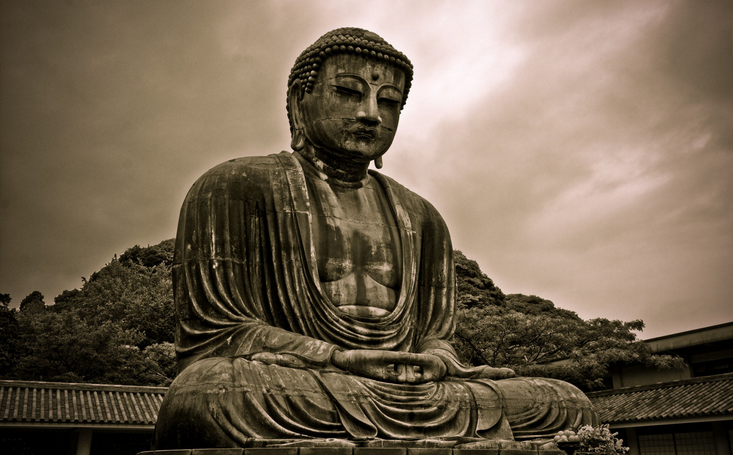
Buddha statueThe Good
After 30-40 minutes, meditation completely eliminated all, even trace feelings of stress and anxiety. This was one of the most significant observations of the challenge period, and it made an incredible measure of difference; one that I didn't anticipate being as effective as it turned out to be. Knowing that I have the ability to reliably remove all stress from my mind made me glad I invested the time into learning to meditate.

Happy faceThe Meditation triggered spontaneous feelings of happiness, bliss (no, seriously — bliss), and tranquility for a period of 2-3 hours following a sit in what I called  The Deep. Every time I entered The Deep, I would get up and walk around after sitting in what I ended up calling the “force field.” Even when walking out onto the busy city streets, it felt vividly like I had a protective bubble around me. Nothing could touch me. I can’t emphasize how profound this feeling was; it was not just regular happiness or contentment, it put me in touch with a deeper strata of emotional experience, the kind of which is only typically encountered perhaps in fleeting instants while watching a picturesque sunset, or the view from an airplane. This state persisted for hours at a time.

Happiness, an Emergent Property of the Still Mind?
I was surprised that in addition to the calming aspect of the practice, what emerged spontaneously was happiness. This result was interesting because it raised the question of how being calm and being happy are related — i.e., whether this kind of happiness can simply emerge from being calm for a long enough period of time. In any case, it was a wonderful experience and, although it took me several weeks to get there, every sit was a joy.
 

The scream
The Unexpected
Meditation did not help me control my stress much outside of the time of sitting.

Aside from affording me a few hours inside the profoundly serene “force field” of the stilled mind, after I got up the next morning and arrived at the office, the stresses and tumult were still there, and I was still just as affected by them — someone would say something aggravating, or a hobo on the bus would be yelling and screaming and my mental and emotional reactions were just as upsetting as they've always been living in the city.

Serenity Now?
It reminded me a bit of the of this Seinfeld clip. If I were living or working in a more peaceful environment, or even if I’d been meditating in the morning, perhaps I would have been able to keep the good feelings going, but as it was, the bliss only lasted so long. Still, knowing that I have the ability to get to The Deep makes me feel like I have some defense against the stresses of everyday life — the city was less oppressive because now know I can escape.

Meditation made the external world seem a bit less important. This is a subtle effect, but also worth mentioning, and can be either good or bad, depending on your responsibilities and goals in life. The process of stilling your mind has the effect of returning you to a sort of “zero point,” which can actually be bad if, for example, there are pressing decisions you need to make, or if there is something you should be genuinely worried, upset, or frantic about. Putting my mind into neutral this way meant that I occasionally had to remind myself that there really was a world outside of my meditative “force field” that demanded my attention. Occasionally, I found myself letting little things slip here and there, not working as actively with the team as I felt I should have.

This was not a major effect, but it was noticeable. I should note that you can probably “tweak” the meditative practice to focus your thoughts on a particular thing rather than stilling them to the zero point. This would likely have the opposite effect, giving you more mental cycles to devote to your work or creative pursuits, however, to me that wouldn’t qualify as meditation so much as it would concentration.


The third eyeThe Really Unexpected
My forehead caught on “fire.” No — really. This was the single most remarkable event of the entire challenge, and I have no explanation for it, but what took place was that after about 30 days, the center of my forehead felt like it was emitting or radiating what I can only describe a kind of heatless, lightless flame. I call it a flame because it produced — I sh*t you not — the distinct, tactile sensation of flickering, like a candle over the surface of my forehead, to the point where when it first began, I actually got up and looked for a window I thought I must have left open. I thought it was a fluke until it never went away (!), so after days, weeks, and then months of increasing intensity and range of motion, I had to concede that it was:
  • not a headache or side-effect of, for example, withdrawing from caffeine;
  • related to the practice of meditation, as it got stronger the more I meditated over the weeks.
Beyond that, I can't speculate. It had zero other apparent effects, positive or negative, but persisted as a kind of weird “meditation exhaust pipe.” After day 60, I felt it constantly, every second of the day, exactly in the middle of my forehead, pulsing in and out in an unobjectionable, but utterly mystifying way.

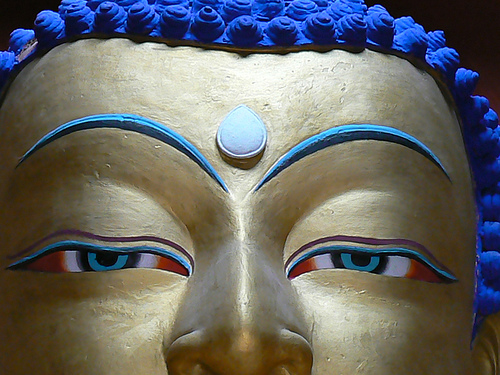
It actually persists to this day, however, as I eased off on meditating after the challenge period was over, it is now not as strong and occurs of its own volition. It’s easy to ignore and does not impair my focus or affect me in any way; it just sort of “is.” Still, it is remarkable to me that it has persisted for nine months after I stopped meditating on a daily basis. The Secret of the Golden Flower (SGF) book talks about it in metaphorical terms (the circulation of the light), and the fact that Buddhist and Hindu iconography, both of which have centuries-old histories of meditative practice, show a dot or flame in that particular region makes me think it is a common, benign artifact of practice. I’d certainly like to investigate it further to discover if any kind of measurements could be taken of it, whether topical or via EEG. (Does anyone with equipment want to measure my forehead? I’m serious! Let me know!) Of course, it wouldn’t surprise me if it was simply psychosomatic.

Celibacy was practically impossible
I probably shouldn’t have been shocked by this finding, considering that libido is an evolutionary imperative, but it was humbling to find that it wasn’t possible for me to give it up completely. Instead, my repeated attempts to remain celibate for longer than two weeks were actually a rather frightening experience, which certainly gave me some insight into, for example, the difficulties the Catholic Church has had with improper conduct by some of its priests.

It simply did not seem healthy to resist this process 100%... and putting guilt on top of it can’t be good for one’s mental health, either. On the occasions when I did break celibacy, it was because the resistance was actually causing my entire mood and personality to morph me into an ill-tempered beast of a man, distracted, irritable, and unable to focus, which prevented me from entering into a meditative state. Because of this, I can’t recommend complete celibacy unless you find that it has no noticeable side effects. Instead I found that a weekly schedule seemed balanced. (Yes, TMI, but it’s for science.)

Don't miss: Part I

Wednesday, April 9, 2014

The Secret of the Golden Flower - Revisited, Part II

For over 40 years, I’ve practiced Golden Flower Meditation (GFM), the method in The Secret of the Golden Flower (SGF) that many adepts recognize as derived from the Buddha’s own meditation system. When I first started, I had no idea it was a manual for activating kundalini...

https://amzn.to/2JiTRhj

Perhaps it was because the Wilhelm translation of the SGF has a poetic quality that obscures unambiguous execution of the meditation teachings embedded in the text. Metaphor rather than easy-to-follow, step-by-step explanation is the norm. A modernized How-To it is not. Terminology often sidesteps the underlying process, hints at it, leaving you to wonder if you are doing it correctly. Some terms overlap in meaning; some techniques are referred to by more than one term. Only by obstinate practice do the techniques become clear.

Nevertheless, I kept at it. I’m not sure why. Part intuition, I suppose. Part distrust of mass movements: I was turned off by Scientology and similar movements that herded initiates toward obedience as dictated by a single leader. Buddha and Milarepa had done it on their own. Why couldn’t I?

Life in 1970 — when I started meditating — was quite different from today. No Internet, not many books on yoga or meditation. It took me over a year to understand the method and practice it in a systematic manner. The one thing that kept me motivated was that, once I caught onto the breathing techniques, I began to detect sensations of energy stirring and flowing throughout my body.

I became a skilled observer, applying techniques in a manner best suited to my particular morphology and soma. I created a step-by-step order for my practice, which turned out to be important because it’s not possible to jump over or skip a step; each one has to be mastered before moving on to the next one.

I stress the point about becoming a skilled observer as much as I stress learning to meditate on your own. Groupthink never gets it done; you can only learn so much from others. The real work is done in the laboratory of your own body. You must become your own best “spiritual” detective.

Individuality vs Groupthink
It Takes Courage to Go It Alone

GFM has entirely reengineered my nervous system, body, and brain. The method is composed of three techniques, each of which must be mastered in turn before beginning the next:

  1. Diaphragmatic Deep Breathing (DDB)
  2. Control of Heart Rate
  3. The Backward-Flowing Method (BFM)
Chi, prana, micro-cosmic orbit
The Backward-Flowing Method

It’s a system that Gopi Krishna, the 20th century’s great elucidator of Kundalini, described as “containing unmistakable hints about the sublimation process.”

He’s referring, of course, to sexual sublimation, a process that uses distilled sexual energy to wake up the nervous system and revitalize the brain and the body, ultimately triggering Kundalini. Although sublimation sounds mystical, it is really a biological process, entailing the diversion of  sexual energy to the brain. Instead of flowing out, as it does during normal sexual intercourse, the seminal fluid, or cervical fluid in a woman, is diverted to the brain in a distilled form known as prana, which is the key to enhanced neuroplastic activity in the brain.

 
Sexual sublimation is the basis of activating Kundalini in whatever form it takes. I say this because the Kundalini experience takes many forms, probably because the sublimation process takes so many forms. Hidden channels can open in dissimilar ways, triggering a flow of distilled sexual energy to the brain that varies according to individual metabolism and soma:
“For a week I observe my breath circulate in the opposite direction without noticing any effect. The mind goes on autopilot and I go back to my uninspired routine: walking, cooking, meditating. Then, two weeks later, about the length of time it takes the backward-flowing process to become permanent, there’s something new. On the day in question, I feel a sensation at the base of my spine like the cracking of a small egg and the spilling out of its contents. For the next month, I observe the fluid-like contents of the egg trickle out of its reservoir and slowly begin to climb my spine. What is this fluid? I can’t describe it exactly. It seems to emanate from the base of the spine and press upward. Each time I sit to meditate, it has risen a half an inch higher.”
~ Excerpted from, Deciphering the Golden Flower One Secret at a Time
Meditating is easy for some, but not for others. It took me a long time to get comfortable with the process, to learn the posture and to concentrate. I was alternately bored and restless, fidgety and impatient, sleepy and indolent. Sitting in the lotus position, my mind used the time to review the events, impulses, and relationships in my life. I was powerless to stop this inner dialogue, to clear my mind of chatter. I knew it could be done; others had written about it. To succeed in meditation, it had to be done; all the teachings said so.

"Nor must a man be led astray by the ten thousand ensnarements. This happens if, after the quiet state has begun, one after another all sorts of ties suddenly appear. One wants to break through them and cannot; one follows them, and feels as if relieved by this. This means the master has become the servant. If a man tarries in this stage long he enters world of illusory desires."
~ The Secret of the Golden Flower

I dropped everything and concentrated on meditation in the hope it would improve my breathing, allowing me to become a better musician. However, sitting in the lotus position, I couldn’t get the breathing right. One day while walking, I decided to sync my breathing to each step, counting my breath over a series of strides. Exhale four counts, hold four counts, inhale four counts, hold four counts. Start over. I practiced a lot, walking great distances until my breathing became regular. The process of counting obscured the chatter, and it gradually disappeared. Eventually, I stopped counting; my mind had emptied. And I returned to sitting meditation, which then kicked into high gear. It had taken me over a year to get my mind under control, but once I was able to, the meditation advanced quickly.
As a result, my Kundalini activated at the age of 35. Energy I didn’t know existed started flowing through the neural channels of my body. I could feel and observe it. Almost immediately, I realized that this pranic, super-conscious energy was the Primal Spirit, a term I’d come across many times in The Secret of the Golden Flower without really understanding what it meant.

It took about three months for this process to complete. I never felt sexual arousal, rather a benign hydraulic sensation, as if a liquid was slowly being “pumped up” my back. Should you succeed in activating "the circulation of the light," as explained in Part I of this post, the outcome will probably differ from mine, or from the next person's. Don't worry about it. You'll find your way.
"When one begins to carry out one’s decision, care must be taken so that everything can proceed in a comfortable, relaxed manner. Too much must not be demanded of the heart. One must be careful that, quite automatically, heart and energy are coordinated. Only then can a state of quietness be attained. During this quiet state the right conditions and the right space must be provided. One must not sit down [to meditate] in the midst of frivolous affairs. That is to say, the mind must be free of vain preoccupations. All entanglements must be put aside; one must be detached and independent. Nor must the thoughts be concentrated upon the right procedure. This danger arises if too much trouble is taken. I do not mean that no trouble is to be taken, but the correct way lies in keeping equal distance between being and not being. If one can attain purposelessness through purpose, then the thing has been grasped. Now one can let oneself go, detached and without confusion, in an independent way."
~The Secret of the Golden Flower
Don't Lose Sight of the Body's Role in This Work
After awakening Kundalini, I was able to visualize my body as a real time, transparent, 3-D model, much like a life-size version of a child’s human anatomy toy model. I could see the defective parts; they lit up and vibrated at a different frequency. I could see how certain parts my body had torqued as a result of their being denied vital life force growth energy. How do I know this to be true? I know it firsthand; it happened to me. I felt and observed the energy rising along my spine, felt and observed it entering my brain. But don’t take my word alone. Test it in the laboratory of your body.
 

Friday, November 22, 2013

The Secret of the Golden Flower - Revisited, Part I

According to the The Secret of the Golden Flower (SGF), the Primal Spirit is the formative energy responsible for our physical embodiment; the Conscious Spirit is the ego and its agents, the senses. The senses feed us an endless flow of information. Society (our parents, teachers, friends, and family) tell us what this information means. What we perceive with our senses becomes reality. What we are taught to believe in and hold as values determines our opinions and beliefs. We think we are free, but we are slaves to the cultural, familial, and educational patterns bequeathed to us. Living under the various illusions we are conditioned to, it is very difficult to extract (de-condition) ourselves without recourse to the primordial super-conscious Primal Spirit.

https://amzn.to/2IN3nWe
When I first read the SGF over 40 years ago, I realized the above interpretation was not clearly stated on the page; I had to read between the lines for the meaning of its teachings. And it wasn't that easy to decipher. I had to live the lines to get the hidden, between-the-lines meaning; I had to practice.

Living the lines meant accepting there was substance to them, even though I wasn't sure what that substance was. It meant practicing the meditation — more like feeling my way through it because, once again, I wasn't sure I was following the instructions correctly, much less understanding their exact meaning. Nevertheless, somewhat to my surprise, I succeeded. My Kundalini became aroused and ultimately active.

I realize some readers may get lost in my trying to relate the details of my Kundalini awakening to the different terminology used in the Indian, Tibetan, and Chinese traditions. The problem is: Kundalini has become an all-encompassing term, too big for one language or tradition alone. So let’s forget terminology for a moment and define Kundalini as a two-step biological process that:

  • Awakens "dormant" energy through sexual sublimation,
  • Releases super-conscious energy throughout the body, once the sublimated sexual energy rises to the brain.
However, while Kundalini is a biological process, it is also a rebirth/maturation process, which most seekers tend to ignore until faced with the prospects of living the rest of their lives with this awakened energy. How does the rebirth process work? Firstly, you must accept Kundalini energy and not struggle against it. Unfortunately, many have trouble with acceptance — to their ultimate chagrin. But let’s say an individual accepts this energy, what next? Kundalini doesn’t only re-engineer your body; it remakes your psyche. Talk about seeing things differently, growing up quickly. Overtime, Kundalini removes conditioning, steers you towards selflessness, and has you doing things you never thought possible, not because you suddenly became smarter and thought them up, but because you were driven to do them. You become an instrument, not in a mindless or robotic way. You are an eddy in the pool of super-consciousness, a part of the evolutionary master plan. At the same time, your rational powers become enhanced, you are able to solve problems and make better decisions. You learn not to choose or support things against nature.


Meditation: Stage 3, The Secret of the Golden Flower

What was it that so captured my attention that I spent two years deciphering and practicing the meditation?

At first, it was the text, the poetic ways it was phrased:
"The great One is the term given to that which has nothing above it. The secret of the magic of life consists in using action in order to attain non-action. One must not wish to leap over everything and penetrate directly."
~ The Secret of the Golden Flower
What's so startling about the above? For me, it was cryptic and at the same time cosmological. More than the Bible or any other explanation I had run across. Intuitively, I understood the notion of the great One and the goal of attaining non-action. That great power resides in stillness. And that's only the first page.
"The work on the circulation of the light depends entirely on the backward-flowing movement, so that the thoughts (the place of heavenly consciousness, the heavenly heart) are gathered together. The heavenly heart lies between sun and moon (the two eyes).

"The Book of the Yellow Castle says: 'In the square inch field of the square foot house, life can be regulated.' The square foot house is the face. The square inch field in the face: what could that be other than the heavenly heart? In the middle of the square inch dwells the splendour."
~ The Secret of the Golden Flower
The phrase "circulation of the light" is used right from the beginning. I understood it to mean an energy phenomenon, something that would occur if I practiced correctly. The designations referred to in The Book of the Yellow Castle were probably related to chakras. I wasn't sure, but I allowed myself to skip over them and proceed with the meditation.
"At the time of birth the conscious spirit inhales the energy and thus becomes the dwelling of the newborn. It lives in the heart. From that time on the heart is master, and the primal spirit loses its place while the conscious spirit has the power.

"The primal spirit loves stillness, and the conscious spirit loves movement. In its movement it remains bound to feelings and desires. Day and night it wastes the primal seed till the energy of the primal spirit is entirely used up. Then the conscious spirit leaves the shell and goes away."
~ The Secret of the Golden Flower
Understanding the meaning of the Primal and Conscious Spirits was gradual. I really didn't get it until Kundalini took effect and I witnessed the changes in myself, observed that a new entity had taken control of my being and was leading me in new directions. Along with the physical changes — the rebuilding of my body, which I freely accepted — came changes in attitudes and life goals. None of these originated from my mental processes. All came from the newly reawakened Primal Spirit. I realize this sounds esoteric, but it's very palpable and real once Kundalini rises.

Most important for the meditator are the passages on posture, attention, and breathing:
"One looks with both eyes at the tip of the nose, sits upright and in a comfortable position, and holds the heart to the center in the midst of conditions. In Taoism it is called the yellow middle, in Buddhism the center of the midst of conditions. The two are the same. It does not necessarily mean the middle of the head. It is only a matter of fixing one’s thinking on the point which lies exactly between two eyes. Then all is well. The light is something extremely mobile. When one fixes the thought on the mid-point between the two eyes, the light streams in of its own accord."

"In sitting down, after lowering the lids, one uses the eyes to establish a plumb-line and then shifts the light downward. But if the transposition downward is not successful, then the heart is directed towards listening to the breathing. One should not be able to hear with the ear the outgoing and intaking of the breath."
~ The Secret of the Golden Flower
Getting these techniques took experimentation. I still don't know if I got everything exactly right. I have to work backwards from the results. The fact that they matched the description of the results in the book means my practice must have been nearly, if not completely, satisfactory.
"The light is not in the body alone, nor is it only outside the body. Mountains and rivers and the great earth are lit by sun and moon; all that is this light. Therefore it is not only within the body. Understanding and clarity, perception and enlightenment, and all movements (of the spirit) are likewise this light; therefore it is not just something outside the body. The light-flower of heaven and earth fills all the thousand spaces. But also the light-flower of the individual body passes through heaven and covers the earth. Therefore, as soon as the light is circulating, heaven and earth, mountains and rivers, are all circulating with it at the same time. To concentrate the seed-flower of the human body above the eyes, that is the great key of the human body."
~ The Secret of the Golden Flower

Not only is The Secret of the Golden Flower a manual on the how-tos of meditation, it also offers descriptions of human ontology/cosmological reality — how, once the meditation successfully takes its course, once the light starts to circulate, the practitioner is catapulted out of the limiting duality of the physical world into the metaphysical actuality of the "great One which has nothing above it."

Today's seeker is impatient, keen on quick results. The SGF advises us not to try to "leap over everything and penetrate directly." Are its teaching still valid in the 21st. century?

Read The Secret of the Golden Flower - Revisited, Part II

Tuesday, September 3, 2013

Holistic Kundalini

 What is Holistic Kundalini? Is it a better way of activating Kundalini? Hardly. There are many ways of activating Kundalini, some better than others — "better," in this instance, defined as tailored to your specific, holistic needs, a method that suits you as opposed to the ones that don't. That's right, not all methods work for all people. Moreover, some people, no matter how much they want it or how hard they try, will never be able to activate Kundalini by any method. That's the Karmic reality.
“One thing has to be remembered about meditation; it is a long journey and there is no shortcut. Anyone who says there is a shortcut is befooling you. It is a long journey because the change is very deep and is achieved after many lives — many lives of routine habits, thinking, desiring. And the mind structure; that you have to drop through meditation. In fact, it is almost impossible — but it happens. A man becoming a meditator is a great responsibility in this world. It is not easy. It cannot be instant. So from the beginning never start expecting too much and then you will never be frustrated. You will always be happy because things will grow very slowly.
"Meditation is not a seasonal flower which within six weeks is there. It is a very, very big tree. It needs time to spread its roots.”
~ OSHO
Curb and sidewalk offer an infinite number of stepping off points
Stepping Off the Curb in Life
Holistic Kundalini. What is it? It's a term I apply to the all around Kundalini life experience: Seeking a method, Practicing the method, Activating Kundalini, Undergoing the awakening experience, Living with Kundalini, and finally Helping others to understand Kundalini. This may seem pretty mundane. "Oh, I know all about that; I've read about it," some initiates tell me. Yes, I've heard it all: Individuals who have not yet even begun a well-founded practice telling me what it is like after reading about it in books. I don't tell them I've lived with Kundalini for over forty years. What's the use? These novices purporting to be experts already know  more than I do. I'm not being facetious: early on in my practice, I realized I knew nothing.

All the myriad of separate, yet overlapping slices of information available to today's seeker form a gigantic pie. That's the blessing of the New Age. But this overabundance is also its curse. Which slice is for me? Some of this information is good and some of it isn't. I'm not competent to judge the content, only wonder if it's had any vetting or peer review?

Still, I can inform people on what to watch out for and how to set expectations. That's Holistic Kundalini — coming full circle, back to the beginning in order to help others understand the process and the stakes.

So I listen to the chatter of novices and move on. When I see them again years later, they're still turning in circles. Why? Simply and succinctly because they weren't grounded in the first place. They didn't have a goal, and you need one. They didn't have a plan, and you need one of those, too. Why? Because just as Osho says, when you expect too much, you're bound to fail. It's built-in into the process, like a sense of entitlement. I've never known it not to fail, never seen it succeed. Strut into this work with a sense of privilege and overarching confidence and you will end up turning in circles.

From the discussions I've had, most people don't have any idea what I mean when I tell them they need a goal and a plan. Yet, if they were building a house, they'd have one of each. Activating and living with Kundalini are similar undertakings. You must know what you're doing, as well as the why and how of it.

Let's think for a moment about setting goals. How should I approach it, you ask? In the first place the goal shouldn't be all about your ego, as if you were just going to the gym to add some more muscle to impress the opposite sex. You should have something you want to accomplish that can only be accomplished by a change of being, a change of consciousness. What might that be? Gopi Krishna defined that change as, "becoming conscious of consciousness." Think about it and you'll see most people aren't.

In my case, I was looking for a way to reverse the effects of a childhood accident. At the time I wasn't able to clearly formulate it, but it was on my mind, and it eventually came to the fore. All I needed then was a plan and that was delivered to me. It took me a while to recognize it, but I finally did. What plan? To decipher and practice the method of meditation in The Secret of the Golden Flower — Golden Flower Meditation. The book was given to me unexpectedly. After a year of puttering and experimenting, I realized I was supposed to do something with it.

To formulate a plan, you must think about your life. Take inventory. How old are you? Is it reasonable to undertake this work now? Who will support you? Can you work and do it? Why do you want to change your being, your consciousness? For selfish purposes? To heal yourself and others? To overcome addiction? You can't think of a goal, but you know you're supposed to do it?

Does a non-goal, or the absence of a goal, constitute a goal? It could; it's better than doing it to acquire occult powers or to make yourself more attractive. And what about a plan? Once you have a goal, it's easy to work out a plan. Just like building a house, once you know what you want to do, it's easy to work out the plan. You take stock of existing tools and techniques. You examine cost, scheduling, strengths and weaknesses, benefits and inconveniences. You make tests. One approach is going to stand out, appear more suited to your person than the others. It's the same with changing your consciousness. You won't succeed if you wake up one morning telling yourself you're going to raise Kundalini because you want to be Governor of Iowa. The two operate in different spheres. You need compatibility, goals and plans suited to your style of living and to YOU.

You also need to think about living with Kundalini. Let's say you're 20 years old, and you've caught the Kundalini bug, or some other Kundalini-related bug. Let's say you work out goals and plans. And you're successful. So at the age of 20, you're living with a permanently active Kundalini for the rest of your life. Are you prepared for this? What kind of person are you? Introvert? Extrovert? Secretive? Outgoing? Fun-loving? Although Kundalini starts to remake your being and change your consciousness, personality tendencies don't change overnight. In fact, you may take on new tendencies temporarily. Negative emotions, dietary changes, sexual dysfunction. Are you prepared to face these things? It took me a long time to learn to live with Kundalini, to understand what it was doing.

I knew I wanted to write about my experience, but at the beginning I couldn't. It took me thirty years before feeling I was ready. Yet, not one day in those thirty years went by without my thinking about and experiencing the effects of Kundalini. Perhaps, with a little pre-thought, a little discussion, you can do better.