Wednesday, June 25, 2014

What to Do While "It Does You!"

There seems to be a polemic building around the notion that "spiritual" work (meditation, praying, attending workshops, seminars, and retreats) takes care of underlying psychic issues, so you don't need to undertake any type of behavioral work to complete the self-actualization process:

"... the vast majority of us who are engaging in spiritual practice are making a similar mistake. We tend to put far too much emphasis on the need to “work out” our personal psychological issues as part of our spiritual path.
"The way this plays out practically is as follows: let’s say that you take up a spiritual practice in earnest, and you notice in the course of that practice that you’re deeply defended against life and intimacy. You won’t let other people see you. You always wear a social mask which hides a deep-rooted insecurity.
"The trouble is that although this “archaeological dig” into the depths of your psyche might lead to greater self-understanding, it won’t necessarily make it any easier for you to be vulnerable, authentic and present. Indeed, it might even take you further away from authentic intimacy with life by making you more self-preoccupied than before.
"It’s important to recognize that this tendency toward self-preoccupation isn’t our fault. This habit grew out of our over-psychologized culture which basically told us that we were all damaged by our childhood and that we have “inner wounds” that need to be healed in order to become happy and fulfilled as adults."
~ The Mistake Most of us Make on the Spiritual Path – Craig Hamilton

This appears to go counter to Margaret Dempsey's hypothesis that some psychic work may be needed, not so much to overhaul the psyche, but to help the individual recognize the ego indoctrination process:

"So before any spiritual work is attempted, I strongly recommend individuals, especially those who have been on a spiritual path for many years, do a transformative, self-development programme. In my case it was the Forum from Landmark Education, but there are others. It's not important which one is done. What is critical is doing something to deal with the sloppy thinking in which one presumes that simply by meditating or doing yoga one is going to transform the ego that stands in the way of awakening. 
"Trying to transform the ego on one's own is like a thief turning detective to catch the one who is the thief; it can't be done and leads to frustration and disillusionment."
The First Stage of Spiritual Awakening: Know Yourself  – Margaret Dempsey

To answer the question "What to Do While 'It Does You!'," I created a diagram of the process that attempts to illustrate what happens when you reach the It Does You! stage. In short, it really does do you!


That is to say the Kundalini-Life Force energy starts re-engineering your being (body, soul, mind, ego, psyche, all) and you can sit back and let it work its evolutionary magic, or as Craig Hamilton says, "... feel instantly connected to the heart of Life and energized by the impulse of evolution itself."

The challenge is, at least for me, that I have been living with this energy for 40 years, exploring, as time went by, many facets of my being, and I don't believe that delving into the various aspects of my being has been counter to the It-Does-You! work that Kundalini carries out on a daily basis. In fact, doing this work has helped change my Being. No longer was I simply a body and a mind, but rather a Being with a capital "B" in it, connected to an energy continuum, like the scent of a pine forest is connected to living trees.

That said, I can see how too much psychic self-analysis might short circuit an individual in the You-do-it! phase, leaving him/her prey to what Hamilton terms "inner wounds." Nevertheless, once you reach the It does You!, there's no harm in gaining insights into how the mind and the ego work, especially as pertains to the finer aspects of social interaction. In my case, I never felt the need for psychoanalysis; I got the point of it after reading Eric Berne's Games People Play.


Sunday by the bay
The Marketplace of Inner Wounds

The work I've done on myself since Kundalini took over has been pretty much confined to self-remembering, which is geared toward the issue of self-control, the key to success in the material world, and I'm not using the preceding term in a materialistic sense. I mean it in the sense of learning to respond instead of to react.

Other than that, any polemic brewing over the question of what to do while pursuing self-actualization is a non-starter. I think all three of us (Hamilton, Dempsey, Semple) are basically saying the same thing: It depends on where you are in the journey:

  • If you're in the You-do-it! stage, beware that psychic contents don't usurp your real intentions.
  • If you're in the It-Does-You! stage, you should have the perspective, and the metaphysical knowledge, to manage the important aspects of your life.

Wednesday, June 11, 2014

Spotlight on Consciousness Research

You’ve visited imaginary worlds and other dimensions in science fiction movies, in comics and in novels. Are they just the writer/director's hallucinogenic fantasies? Or are these dimensions actually KNOWABLE? If so, how can we prepare ourselves for this type of altered perception?

Jacob’s Ladder. The Matrix. Memento. Altered States. Fictional worlds in which material reality suddenly melts away and the protagonist is left to fend for himself in harrowing, seemingly unreal situations. We’ve witnessed these worlds and believed them to be figments of the writer’s imagination. But are they?


Chico store window display
Undersea World of the Mind

These so-called imaginary worlds are as real the people, streets, houses, and stores we encounter in our normal daily rounds. Although we cannot see these apparitions in our current state, scientists and other investigators are finding they are real. Moreover, they are not the threatening specters moviemakers would have us believe — but simply exist beyond the reach our limited consciousness.

At a key moment in Jacob’s Ladder, Jacob's friend, chiropractor and guardian angel Louis (Danny Aiello), cites the 14th century Christian mystic Meister Eckhart — “Eckhart saw Hell too; he said: ‘the only thing that burns in Hell is the part of you that won't let go of life, your memories, your attachments. They burn them all away. But they're not punishing you,’ he said. ‘They're freeing your soul. So, if you’re frightened of dying and... you’re holding on, you'll see devils tearing your life away. But if you’ve made your peace, then the devils are really angels, freeing you from the earth.’”


Street Fair
Materialism - From High Water to Hell

This is straight out of The Tibetan Book of the Dead. In fact, this film is a fictional interpretation of a Near Death Experience (NDE). At the end we see “Jacob never made it out of Vietnam.” His body is shown in an army triage tent just as he expires. Apparently, the entire series of events turns out to have been a dying hallucination. Jacob's experiences appear to have been a form of purgation in which he releases himself from his earthly attachments, finally joining his dead son Gabe to ascend a staircase (Biblically known as Jacob's Ladder) toward a bright light.”

The science of consciousness, or should we say the scientific investigation of it, inevitably delves into the unseen — that which lies behind the physical — the metaphysical. This investigation is now moving forward on two fronts (metaphysical investigation and physical science) toward the same objective, namely the full unfolding of consciousness, or as Gopi Krishna called it: "Knowing the Knower."

Much investigation is still outside the realm of traditional science, yet, as metaphysical exploration moves forward, we apply more scientific methods, which caused JJ Semple to wonder, "Who's to say that the same scientific methods we apply in the physical realm won't someday apply to the metaphysical realm? The NDE provides palpable evidence of meta-physicality.” 

This exploration is being conducted by two informal, loosely-knit research tendencies, not by any sanctioned organization. Nevertheless, it moves forward with a dynamic élan, prompted, I believe, by what Gopi Krishna called "the evolutionary impulse." Metaphysical investigators explore consciousness from the inside-out while physical scientists explore it from the outside-in. Instead of sniping at one another, they need to cooperate:


Group 1: Metaphysical investigators

Metaphysical investigators, those who have undergone Kundalini/NDE experiences, write about them from the inside-out, just as a 16th Century explorer might have kept a journal of his adventures during a sea voyage. This inside-out group is headlined by such researchers as, Gopi Krishna, Richard Bucke, J Krishnamurti, and PD Ouspensky, who cautioned that metaphysical research in the laboratory of the body deserves a rigorous methodological approach:

"There is no question of faith in all this. Quite the opposite, this system teaches people to believe in absolutely nothing. You must verify everything you see, hear, or feel. Only in that way can you come to something."

In keeping with this approach, JJ Semple described his experience in Deciphering the Golden Flower One Secret at a Time: “After activating the Kundalini-Life Force, I was able to see the blueprint of my perfect body and compare it to my actual state. Amazingly, the Life Force recognized my deformity and immediately began to correct it. I witnessed it slowly reshape my body to the exact proportions in the blueprint.

“I could see my original design and the fact that it is perfect means that an unseen sentient entity in nature created it before my substantive being came into this world.”

These observations are alluded to in the writings of other Kundalini researchers, such as Michael Bradford:

"This control and guidance is also evident in the experiments done with developing animal embryos in which the removal or substitution of tissue, if done at an early enough stage, does not result in a totally deformed final form but rather in a smaller or modified, but still complete form. If the process of development were strictly a mechanical one, this would certainly not be the result. One logical explanation for this phenomenon is the existence of a controlling field, such as the pranic spectrum, which has a pre-determined form towards which it is guiding the development of the organism via the growth processes.”

In The Backward-Flowing Method: The Secret of Life and Death, JJ Semple wrote, “Where this blueprint had been stored between the time of my conception and my 35th year, I did not know. Physical scientists, geneticists, in this instance, would probably say it resides in the brain, and that is a safe assumption, for, until we can prove it resides outside the body, we must assume it is somehow connected to it, as in lines of code stored in DNA. Nevertheless, the fact that I saw the blueprint and watched the Life Force energy use it to “reengineer” my body makes me think that some sentient agency must play a role in reproduction, and in the design and formation of the body. Why had this blueprint suddenly reappeared? Where had it been for thirty-five years? Why was the Kundalini-Life Force using it? If it had no purpose, wouldn’t it have ceased to exist? So then, it must have a purpose, for it was still there.” Does the notion of controlling field (an outside the body metaphysical entity) come into play?

In The Biology of Consciousness: Case Studies in Kundalini, JJ Semple continues this discussion:

"As applied to my situation, the 'controlling field' referred to in the above passage used a blueprint of my perfect body to manage my bodily substantiation. The changes in symmetry I experienced were due to neural blockages caused by the splinter — blockages causing a massive redistribution of growth energy throughout my body. Ergo, my transformation from a symmetrical to asymmetrical being. Not only did this newly awakened pranic energy reverse this process, it started it going in the other direction, namely from asymmetrical back to symmetrical. It healed me, and it did so intelligently, which made me realize it had access to DNA and other evolutionary information about my being. And that is what I base my hypothesis about Kundalini’s ability to modify DNA on: finding a way to restore and revitalize the affected body parts, a process that included conforming my body to the blueprint for its intended substantiation. It still amazes me that 35 years after my birth, this 'controlling field' or super-consciousness went back to my 'archives,' found the blueprint, and used it to restore my body to its original intended state and form."
Group 2: Physical scientists
Physical scientists, such as Dr. Harold Saxton Burr of Yale University, who explored field theory in the 30s. “Physicists define a field something like this: when something occurs somewhere in space because something else happened somewhere else in space, with no visible means by which the cause produced the effect, the two events are connected by a ‘field.’ If this is true, then:
"As everyone knows, when we sprinkle a card with iron filings and hold it over an ordinary magnet, the filings will arrange themselves in a pattern that represents the ‘lines of force’ of the magnet’s field. And though we can change the filings as often as we like, each set of filings will always assume the same pattern.
 “Even by the most pedantic, therefore, the ‘fields of life’ can be considered a scientifically-respectable phenomenon, eligible one day for the imprimatur of the hierarchy. When that will be will depend on how long it takes biochemists to lose their enthusiasm for present fashions (and perhaps for economic interests to open their focus to cost-effective natural vs. patented chemical solutions)."
  • The fact that we do not perceive these states/fields means our current consciousness must be inhibited,  
  • There is consciousness in every field/cell.

As author Sol Luckman points out:

“A salient point in the evolutionary model I am elaborating is that evolution of species ultimately is driven not by material, but by metaphysical energy, or consciousness, of a spiraling, 'meta-genetic' nature.
“If today we are to embrace a worldview in which consciousness is more important than matter, we need to base our timekeeping on the nonphysical, invisible reality (that gives rise to reality) rather than on the physical.”

If both groups combine their efforts, they will uncover actualities that make the themes explored in science fiction a reality, enabling, as Gopi Krishna so aptly phrased it, "a state of perception where the invisible world of intelligent cosmic forces will be cognizable to every human being."

Thursday, June 5, 2014

Who Looks Outside, Dreams; Who Looks Inside, Awakens


The title of this post is taken from a plaque I received as a Christmas present a couple of years ago from a good friend. When I tore the wrapping off and read it, I felt a shiver go down my spine as the truth of the words resonated. Since receiving it, I have pondered what the words "to Awaken" mean in practice.

The Buddha, when asked "Who are you?" said, "I am Awake." To be Awake means to break free of the bonds Maya, what the Buddhists call the world of illusion and delusion. To see reality as it really is, not as it appears to be, is to realize the unity behind the perceived separation. As Jung said all those years ago, to look outside is to never find the treasure that lies within. To look externally for what can only be found inside is the trap human consciousness falls into. Awakening is an inner process. External factors can aid in this process, but the ultimate Awakening is an awakening of inner consciousness that shifts the perception of the world and brings alive, insights, intuition and illumination.

To be Awake means to realize that our thoughts and feelings are not who we are. It means to experience an aspect that has nothing to do with thoughts and feelings: SOMETHING that remains constant when thoughts and feelings change, SOMETHING that remains stable and enduring when everything else is shifting and changing. To be Awake is to be in contact with this SOMETHING. To stand apart from the drama, not by being detached, but because of the realization that it is not real even though it appears to be very real. To be Awake is to be in contact with a higher level of consciousness, such that life flows and has a harmony and balance it didn't have before. Yet, life after awakening continues much as it did before, which is the paradox of the entire process. The difference is in the quality of that life and how events in life are dealt with. A Zen description of this says, "Before Awakening, chop wood, carry water; after Awakening....chop wood, carry water." Same actions, but the context within which the actions are being done shifts; the 'I' (subject) is no longer, there is simply the action of chopping wood and carrying water.


Prior to Kundalini awakening, I felt a need to control everything in my life. The result of this was generalized anxiety and loss of freedom. The realization of this need to control, deeply buried in my subconscious, came about not by reading a spiritual book, but by having a conversation with a coach who I had been doing some transformative self-development work with as the leader of a team.

She said, "It’s like having a five year old in charge of the team: you don’t listen and you make people wrong." When she said that to me, I felt like I had hit a wall, which I had — the wall of my own obsessive need to control. I couldn’t listen to people because I wouldn’t be in control. It was my way or the highway, and I realized that this way of being stemmed from a decision I had made when I was young: that life was scary and it had be controlled — hence the rigidity and inflexibility I showed when members of my team made suggestions about doing something differently than the way I wanted it done. Realizing this, I also realized the absolute absurdity of the decision. There is no way to control life or what happens and, in that moment of realization, I let go of my need to control. By hitting the wall, which is what happened, I got to see the impact that my controlling way of being was having on the members of my team. I gave it up, thus creating the possibility of freedom and I have to say the results have been nothing short of miraculous in terms of how I have been able to flow and respond to life.


As a result of this experience and insight, I am convinced that the ability to operate from an Awakened state of being is closely linked to the letting go of control. To accept what is and surrender to it. The funny thing is that I have often written about the importance of surrendering when on the spiritual path. I realize now that after surrendering so completely when Kundalini rose in 1999, I went right back to trying to control everything in my life and my environment. This is because the need to control was hidden from my view. Until it became shown to my consciousness, it had power over me. The rising of Kundalini set in motion the events that would result in my having to confront this decision and its impact.

Now, so many years later, I understand the full meaning and impact of control. I also see that nobody made me take the decision that I had to control life; it was me alone. This decision to control life is something most humans make. At some point, our environment fails us in that it doesn't behave the way we expect it to. In the face of this failure, it is natural to say, "I will control things from now on."


So like me, the child might become bossy and domineering — always demanding his own way. Or it might show itself in other ways, but being bossy is the gold standard of control. I smiled when I heard my four-year-old niece acting assertive and bossy. At four it's cute, but 40 years later it can result in a very narrow, limited life. However, it's a highly successful and lucrative strategy that motivates many to achieve, but it isn't for me. I am so grateful that I was given the grace to realize this and the choice of whether to give it up or not.

Friday, May 30, 2014

The Fountain of Life

Kundalinie centra
Marie-Andrée Brands made the drawing
Margriet Born gave the aura colors

How does the kundalini gland

Transmute life energy close at hand

Into superintelligent rain,

Up the spine and into the brain?


It is a fountain veritably,

An upward flowing ceaselessly,

The pressure to create, to form new life,

New paintings and poems, new ideas rife.


The alchemy to concentrate

Spiritual energy at a higher rate

Is a magic that beliefs cannot describe,

A knowledge that eludes the modern scribe.


But flow it does, bringing creativity,

Values noble and improved morality,

Better health and decreased aging,

A superior heart, body, soul and brain.


This is the future of the human race, some say,

The next step on the evolutionary Way,

Portending a better woman and man,

All part of a predetermined Plan.


Neil Bethell Sinclair
Emeryville
May 30, 2014

Monday, May 26, 2014

We Prefer Listening to Doing

Jesus, Lao Tse, and Buddha didn't aim to start the religions they're associated with. That phenomenon was the by-product of their personal search for truth. The fact that, at one point in their lives, each of them went on a lonely quest for knowledge, using the tools available at the time, i.e., using their bodies as laboratories. They weren't thinking about religion or about science. Yet, the discoveries they made during their fateful retreats turned out to be the precursors of both religion and science.

Struggle of Good and Evil
He Talks; She Listens

Each of them had absented themselves for a time from their worldly preoccupations to practice a solitary meditation, and it was through this practice that they awakened Kundalini, that placeholder term we use to denote the evolutionary energy in man. Other traditions have other names for it: Chi, orgone, or life force. The names aren't important; they are interchangeable.

As Thomas Cleary says in his translation of The Secret of the Golden Flower: "From the point of view of that central experience, it makes no difference whether one calls the golden flower awakening a relationship to God or to the Way, or whether one calls it the holy spirit or the Buddha nature or the real self. The Tao Te Ching says, 'Names can be designated, but they are not fixed terms.'”

What did these men discover? They discovered a hidden sub-system inside their bodies which, properly aroused, opened the doors to higher consciousness and led them to infer an ontology for human potential beyond anything science knows today. They were doers, not talkers, impelled by what Gopi Krishna called the evolutionary impulse. An impulse to self-actualization written into our DNA. What is the mechanism behind self-actualization that they shared? According to historical research, they shared the practice of meditation. It was through meditation that they came to the discovery of the dormant evolutionary energy in every human body.

The Seventh Seal in Drag
On Alert

Only after making their discoveries did they begin talking about them. First they practiced, then they talked. It was as if they were saying: Do before talking, and when you do talk, talk about doing.

These men didn't talk about religion; they talked about doing. They realized that talking was an excuse for not doing. Unfortunately, the doing part has become lost, especially here in the West.


However, if you look carefully at the religious teachings surrounding their discoveries and boil them down to their barest denominators, they amount to not much more than the Golden Rule: do unto others as you would have them do unto you. A simple enough maxim to enunciate, but quite difficult to adhere to in practice. The very fact we in the West call our religions faiths, not practices should give some indication of what we're dealing with. In other words, traditional religion means: I'm going to talk, and you're going to listen. I'm going to give you my opinion on what you should think and believe. Never mind about verifying; shut up, listen, and believe.

Don't blame the progenitors. They didn't actually start the various religions named after them. In fact, Jesus Christ wasn't a Christian; Lao Tse wasn't a Taoist, and Buddha wasn't a Buddhist. The recruiting, party-member stuff came later, after camp followers, sycophants, and spin doctors began politicizing and formalizing their teachings, turning them into money-making organizations. It was after the fact that these religions were named for their progenitors.

Yes, there is still a residue of legitimate devotion to the initial discoveries those pioneers made about human evolution and how we might speed it up in order to avoid the pitfalls of negative emotion, greed, war, racial hatred, wanton violence. But much of their teaching about meditation has been lost over the centuries and we are left with the man-made dogmas and doctrines that have nothing to do with doing.

Yes, we love to listen; we hate to do. In the first place, DO WHAT? What is it I should do? How do I know WHAT to do? In the second place, I don't have time. In the third place, I don't have any guarantee it would work. In the fourth place, it can't be any good if I don't have to pay a lot for it. In the fifth place, it can't be very helpful if Oprah hasn't mentioned it. And so on...


Waiting for the Next Messiah
Well, the meditation methods they practiced still work and are still doable today. That's right, whether for spiritual, religious, or scientific purposes, individuals are still using their bodies as laboratories, pushing the evolutionary envelope. One thing you need to know: in this long evolutionary journey we have not yet accomplished very much. There's still much distance to cover. We are but mere outlines of our potential. Enlightenment, self-actualization, self-realization are not carved-in-stone achievements; they are milestones in an on-going process that is never completed, but keeps us continually reaching for completion.

Friday, May 9, 2014

100 Days of Meditation - Part II, Results & Observations


Buddha statueThe Good
After 30-40 minutes, meditation completely eliminated all, even trace feelings of stress and anxiety. This was one of the most significant observations of the challenge period, and it made an incredible measure of difference; one that I didn't anticipate being as effective as it turned out to be. Knowing that I have the ability to reliably remove all stress from my mind made me glad I invested the time into learning to meditate.

Happy faceThe Meditation triggered spontaneous feelings of happiness, bliss (no, seriously — bliss), and tranquility for a period of 2-3 hours following a sit in what I called  The Deep. Every time I entered The Deep, I would get up and walk around after sitting in what I ended up calling the “force field.” Even when walking out onto the busy city streets, it felt vividly like I had a protective bubble around me. Nothing could touch me. I can’t emphasize how profound this feeling was; it was not just regular happiness or contentment, it put me in touch with a deeper strata of emotional experience, the kind of which is only typically encountered perhaps in fleeting instants while watching a picturesque sunset, or the view from an airplane. This state persisted for hours at a time.

Happiness, an Emergent Property of the Still Mind?
I was surprised that in addition to the calming aspect of the practice, what emerged spontaneously was happiness. This result was interesting because it raised the question of how being calm and being happy are related — i.e., whether this kind of happiness can simply emerge from being calm for a long enough period of time. In any case, it was a wonderful experience and, although it took me several weeks to get there, every sit was a joy.
 

The scream
The Unexpected
Meditation did not help me control my stress much outside of the time of sitting.

Aside from affording me a few hours inside the profoundly serene “force field” of the stilled mind, after I got up the next morning and arrived at the office, the stresses and tumult were still there, and I was still just as affected by them — someone would say something aggravating, or a hobo on the bus would be yelling and screaming and my mental and emotional reactions were just as upsetting as they've always been living in the city.

Serenity Now?
It reminded me a bit of the of this Seinfeld clip. If I were living or working in a more peaceful environment, or even if I’d been meditating in the morning, perhaps I would have been able to keep the good feelings going, but as it was, the bliss only lasted so long. Still, knowing that I have the ability to get to The Deep makes me feel like I have some defense against the stresses of everyday life — the city was less oppressive because now know I can escape.

Meditation made the external world seem a bit less important. This is a subtle effect, but also worth mentioning, and can be either good or bad, depending on your responsibilities and goals in life. The process of stilling your mind has the effect of returning you to a sort of “zero point,” which can actually be bad if, for example, there are pressing decisions you need to make, or if there is something you should be genuinely worried, upset, or frantic about. Putting my mind into neutral this way meant that I occasionally had to remind myself that there really was a world outside of my meditative “force field” that demanded my attention. Occasionally, I found myself letting little things slip here and there, not working as actively with the team as I felt I should have.

This was not a major effect, but it was noticeable. I should note that you can probably “tweak” the meditative practice to focus your thoughts on a particular thing rather than stilling them to the zero point. This would likely have the opposite effect, giving you more mental cycles to devote to your work or creative pursuits, however, to me that wouldn’t qualify as meditation so much as it would concentration.


The third eyeThe Really Unexpected
My forehead caught on “fire.” No — really. This was the single most remarkable event of the entire challenge, and I have no explanation for it, but what took place was that after about 30 days, the center of my forehead felt like it was emitting or radiating what I can only describe a kind of heatless, lightless flame. I call it a flame because it produced — I sh*t you not — the distinct, tactile sensation of flickering, like a candle over the surface of my forehead, to the point where when it first began, I actually got up and looked for a window I thought I must have left open. I thought it was a fluke until it never went away (!), so after days, weeks, and then months of increasing intensity and range of motion, I had to concede that it was:
  • not a headache or side-effect of, for example, withdrawing from caffeine;
  • related to the practice of meditation, as it got stronger the more I meditated over the weeks.
Beyond that, I can't speculate. It had zero other apparent effects, positive or negative, but persisted as a kind of weird “meditation exhaust pipe.” After day 60, I felt it constantly, every second of the day, exactly in the middle of my forehead, pulsing in and out in an unobjectionable, but utterly mystifying way.

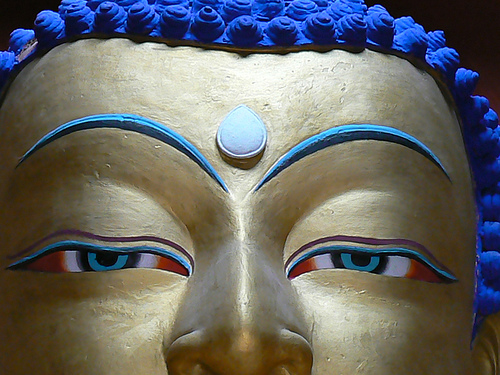
It actually persists to this day, however, as I eased off on meditating after the challenge period was over, it is now not as strong and occurs of its own volition. It’s easy to ignore and does not impair my focus or affect me in any way; it just sort of “is.” Still, it is remarkable to me that it has persisted for nine months after I stopped meditating on a daily basis. The Secret of the Golden Flower (SGF) book talks about it in metaphorical terms (the circulation of the light), and the fact that Buddhist and Hindu iconography, both of which have centuries-old histories of meditative practice, show a dot or flame in that particular region makes me think it is a common, benign artifact of practice. I’d certainly like to investigate it further to discover if any kind of measurements could be taken of it, whether topical or via EEG. (Does anyone with equipment want to measure my forehead? I’m serious! Let me know!) Of course, it wouldn’t surprise me if it was simply psychosomatic.

Celibacy was practically impossible
I probably shouldn’t have been shocked by this finding, considering that libido is an evolutionary imperative, but it was humbling to find that it wasn’t possible for me to give it up completely. Instead, my repeated attempts to remain celibate for longer than two weeks were actually a rather frightening experience, which certainly gave me some insight into, for example, the difficulties the Catholic Church has had with improper conduct by some of its priests.

It simply did not seem healthy to resist this process 100%... and putting guilt on top of it can’t be good for one’s mental health, either. On the occasions when I did break celibacy, it was because the resistance was actually causing my entire mood and personality to morph me into an ill-tempered beast of a man, distracted, irritable, and unable to focus, which prevented me from entering into a meditative state. Because of this, I can’t recommend complete celibacy unless you find that it has no noticeable side effects. Instead I found that a weekly schedule seemed balanced. (Yes, TMI, but it’s for science.)

Don't miss: Part I

Wednesday, April 30, 2014

We Are Born Into This World

Grace Cathedral

We are born into this world, into our fate,
Driven by a will to live,
Inheriting our present moment,
Our ancestors,
Our history,
Our natural world.
 

We are born with the freedom to choose,
And that choice is:
To follow our evolutionary impulse, to grow and do good;
Or to pursue a less noble path,
Against our conscience.
 

To choose the evolutionary path, some would call Tao, some the Path of Knowledge, some the Way,
Is to follow our hearts.
To follow this path is to face fear and grow courage,
To find clarity,
To gather power,
To accumulate wisdom,
And in the end to know death.

One cannot follow this evolutionary impulse without the awareness of this choice.
To be awakened to this choice is to become religious in some sense,
To become aware of the spiritual world we live in, and the consequences of our choices,
To accept that a solely rational thought process excludes and denies intuition,
Upon which so much depends.


It is to accept the value and meaning of inspiration,
To create,
To dance, paint, sculpt, write, to invent,
To help others, to feel the earth’s heartbeat
In our own hearts,
To reflect the music of the deeper world
In the radiation of our beings,
In our light and life.

Therefore, if we wish to enjoy this life,
We must cultivate our awareness of this evolutionary impulse within us, and
Choose to believe that our choice to follow it is for our own good and the good of the world.

Tuesday, April 29, 2014

Finding Balance in the Effort to Integrate Kundalini

One day there was a Me; the next day there wasn’t. One day I was practicing meditation, breathing in and out in a rhythmic manner; the next I was transported to another dimension I’ll never be completely able to explain or describe. That doesn’t mean I’m going to stop trying. After all, I have one advantage: I never really returned from that other dimension; I live with a foot in both — the physical world we know as the “real world” and that other dimension. To describe it, I use terms from science as well as those from various spiritual traditions, not because I like arcanum or confusion, but because when I say kundalini, you’ll say chi, someone else will say orgone; and we’ll be talking about the same thing without knowing it.


Legs up
Are You Upside Down or Rightside Up
Nevertheless, once it happens to you, you'll understand how unimportant terminology is. Each awakening experience is only a different manifestation of the same energy. Sure, it involves struggling with terminology and understanding the same notions phrased in slightly different ways. The closest we get to clarity is a series of approximations of an actual awakening experience. And that's perfectly understandable because it’s not easy to express or describe. But there is a constant: everyone who experiences Kundalini has one foot permanently in that other dimension.


Mahatma Gandhi
Self-explanatory
There’s a corollary to that constant, one we learn, not during the Kundalini activation experience per se because during the experience we are floating in a no-mind state, at least I was. Immediately after — when we “come back to our senses” — we know there is an all-pervading consciousness behind the universe and behind human evolution. It’s not a hallucination or a projection of aberrant mental activity.

This consciousness is much greater than our bodies or the physical world we perceive. We are part of it, contained in it. In this consciousness, nothing is separate. All is Whole and Undivided. This cannot be learned in school or books, it can only be Known.


Hula hoop
Ever Increasing Concentric Circles
Very few of us progress straight from birth to self-actualization. To perceive whole and undivided Oneness, we first serve an apprenticeship, as it were, in a world of duality, a world in which every aspect seems to be in opposition to every other. This is not reality; it is the world of the senses, one we are conditioned to from birth. Once we recognize that we are conditioned to think in terms of duality, we are able to find ways and means of extracting ourselves from that conditioning; and we are offered the opportunity to do so.

Many individuals are so completely conditioned they remain that way for the rest of their lives. Some are able to recognize this conditioning. A few are able to work their way through it to the cosmological Oneness behind duality. Those who achieve this may attempt to integrate this knowledge with their real world lives; others are content to remain immersed in the bliss they’ve discovered. I chose a balance: remaining in the world, at the same time, realizing I am a part of an Energy Continuum. I didn’t really choose It; It chose me. That’s the kind of purposeful compulsion Kundalini introduces into our lives. After awakening, we can’t take credit for anything we do, say, or write. We are driven to it.

Yet, spurred on by an urge to understand my experience to the extent I can — how conventional science views evolution as opposed to how someone like myself, a person with a foot in two different worlds, perceives it — I concluded that Kundalini is an evolutionary force with a guiding intelligence behind it, and I looked for an evidence-based paradigm for examining it.


Now Playing
Let's All Go to the Movies
Science recognizes “survival of the fittest” and “natural selection” as the operative mechanisms behind evolution. But is there another mechanism working at a higher level, one Gopi Krishna called the evolutionary impulse? Not perceptible by everyone at this time, this mechanism drives certain beings toward super-consciousness, allowing them to recognize and access energy fields beyond the confines of the circumscribed physical universe, beyond the five senses. Those who do experience it say this super-consciousness manifests itself as vibrational energy. If so, could it become perceivable at some future time by all humans as a result of a rapid surge in the quality of human evolution? A new tip of Maslow’s pyramid dedicated to higher consciousness? In other words, could all human beings eventually become conscious of consciousness at each and every moment of their lives?


Hand to mouth
Preparing for the July Fourth Nacho Eating Contest
Is the objective study of Kundalini a fool’s errand? Perhaps, but Kundalini is a many-sided subject. I believe we can learn from an evidence-based approach to studying its role in evolution.